
Galvani, Volta, and the Birth of Bioelectricity
Every essay in this Journal traces a lineage — the idea that living tissue carries real, measurable electricity. This is where the argument began: two Italians, one twitching frog leg, and a dispute so productive it founded two sciences at once. Luigi Galvani thought he had found a special "animal electricity." Alessandro Volta thought Galvani had found nothing but his own metal instruments — and in proving it, built the first battery. The strangest part of the story is the ending: the man who was wrong gave us electrophysiology, and the man who was right gave us the battery. Science kept them both.
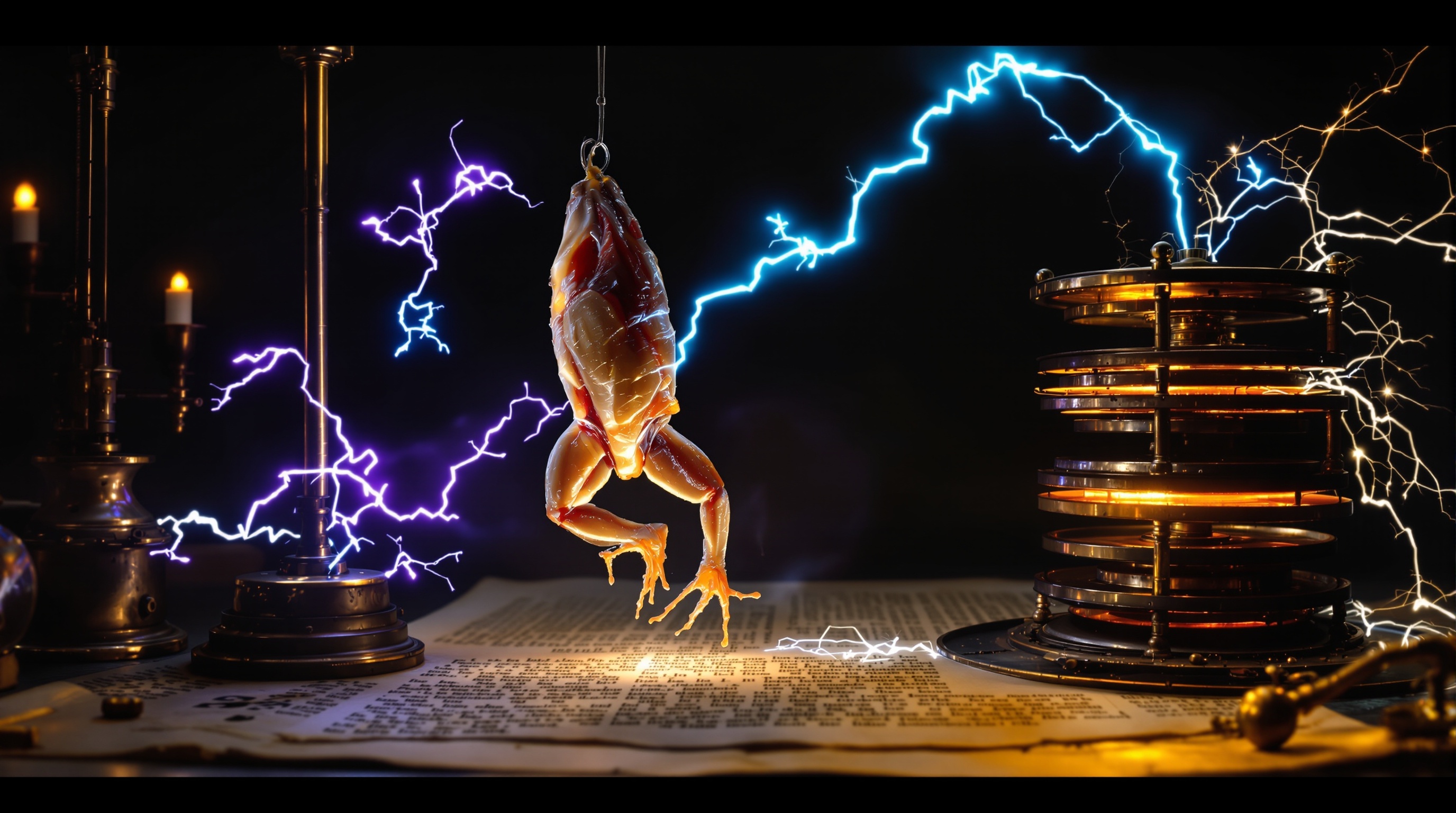
The twitch in the Bologna laboratory
Luigi Galvani (1737–1798) was not a physicist chasing a theory of electricity. He was an anatomist and obstetrician in Bologna, a careful dissector of nerves and muscles, a man of the scalpel more than the spark. Sometime in the 1780s — the exact first observation is genuinely uncertain, and honest sources hedge it[4] — he noticed something that would occupy him for the rest of his life: a dissected frog's leg, its crural nerve exposed, contracted sharply when touched by a metal instrument, apparently with no external electrical source present.
He chased the effect with the patience of an anatomist. In one famous arrangement, described in 1786, he hung prepared frog legs on brass hooks from an iron railing on his balcony and watched them twitch as they touched the iron — associating the contractions with two dissimilar metals and the open air.[5] In 1791 he gathered years of work into a single Latin treatise: De viribus electricitatis in motu musculari commentarius — "Commentary on the Effect of Electricity on Muscular Motion."[1] Its central claim was audacious. The electricity, Galvani argued, was not coming from outside. It was intrinsic to the animal — an "animal electricity," stored in the muscle much as charge is stored in a Leyden jar and discharged through the nerve to drive the contraction.
Volta's objection — and the battery that answered it
Across northern Italy, in Como, the physicist Alessandro Volta (1745–1827) read the treatise with mounting admiration and then mounting doubt. At first he accepted Galvani's animal electricity. But by 1792–94 he had turned skeptic, and his objection was devastatingly simple. Look, Volta said, at what is actually in your experiment: two different metals — brass and iron, copper and zinc — joined through a moist, salty conductor. The frog's leg is not the source of the electricity. It is only an exquisitely sensitive detector of it, a moist electrometer twitching at a current generated by the junction of the dissimilar metals themselves.
This was a real scientific dispute — data against data, not ego against ego — and Volta chose to settle it in the most consequential way imaginable. To prove electricity could be produced by metals alone, with no animal anywhere in sight, he stacked discs of zinc and copper separated by brine-soaked cloth and produced a steady, continuous current. On 20 March 1800, he announced the device in a letter to Sir Joseph Banks, President of the Royal Society.[2] It was the voltaic pile — the first electric battery — and it was born directly out of the effort to disprove Galvani. Volta even likened it, revealingly, to the natural "artificial electric organ" of the torpedo fish. He had won the argument. Galvani, who had died in 1798 stripped of his university post for refusing a loyalty oath to Napoleon's new republic, did not live to see the battery that his frog had provoked.
Volta set out to show there was no electricity in the animal — and in doing so invented the machine that would let us finally measure the electricity in the animal. The refutation built the instrument of the vindication. — on the Galvani–Volta debate
Both headline-wrong, both footnote-right
For a generation, Volta's contact theory reigned and "animal electricity" looked like a beautiful error. But science rarely lets a good half-truth stay buried. The honest verdict, two centuries on, is that each man was wrong about the headline and right about the footnote.
Volta was right that dissimilar metals in an electrolyte generate a current — that is textbook electrochemistry, and much of Galvani's twitch really was this bimetallic artifact. But Galvani had one experiment Volta could not fully explain away: he reported contractions with no metal at all, when a cut nerve was laid directly across muscle. That was the fingerprint of something the frog itself was making. Galvani was wrong that this was a unique vital fluid categorically unlike ordinary electricity — it is the same electricity, produced by ion gradients across cell membranes — but he was right on the point that mattered most: living tissue generates its own genuine voltage.
The vindication: Matteucci to Hodgkin–Huxley
The confirmation came in careful steps. In the 1830s and early 1840s, Carlo Matteucci, armed with the newly sensitive galvanometer, detected the "injury current" — a real, measurable current flowing from intact to damaged muscle. Tissue-generated electricity was no longer an inference; it was a reading on a dial. Building directly on Matteucci, Emil du Bois-Reymond published Untersuchungen über thierische Elektricität in 1848 and founded modern electrophysiology, describing the "negative variation" — a precursor of what we now call the action potential (the modern concept belongs to a later era, so the word to use is precursor, not discovery).[4] Julius Bernstein's 1902 membrane hypothesis supplied the theory: the potential arises from selective ionic permeability across the membrane. And in 1952, Alan Hodgkin and Andrew Huxley closed the loop with a quantitative, ionic model of the action potential in the squid giant axon — voltage-gated sodium and potassium currents producing a self-propagating spike, work that earned the 1963 Nobel Prize.[3] Galvani's intuition, refined past all recognition, had become exact science.
- Step 1 · Volta's artifactDissimilar metals make currentTwo different metals in a moist conductor generate a contact/electrochemical potential — real electrochemistry, and the battery. This is what confounded much of Galvani's twitch.[2]
- Step 2 · Galvani's residueTissue is not a passive wireContractions with no metal at all pointed to something the living tissue itself produced — not a vital fluid, but a genuine intrinsic charge.[1]
- Step 3 · The membrane potentialEvery cell holds a voltageExcitable cells maintain a resting potential (~ −70 mV) across the membrane — measured as Matteucci's injury current, formalized by du Bois-Reymond and Bernstein.[4]
- Step 4 · Ion gradientsSodium and potassium, the real batteryUnequal Na⁺/K⁺ concentrations across the membrane, maintained by pumps and channels, set and power the potential — the cell's true source of charge.
- Step 5 · The action potentialHodgkin–Huxley, 1952Voltage-gated Na⁺ influx then K⁺ efflux produces a self-propagating spike — the quantitative, ionic vindication of Galvani's intuition that life runs on real electricity.[3]
Established: Galvani conducted the frog-leg experiments and published De viribus electricitatis (1791); Volta's bimetallic contact theory is correct electrochemistry and produced the first battery (1800); living tissue genuinely generates electricity, confirmed from Matteucci (1830s–42) and du Bois-Reymond (1848) to Hodgkin–Huxley's ionic action potential (1952). Overstated in its day: Galvani's framing of muscle electricity as a unique "vital fluid" distinct from physical electricity — it is ordinary electrochemistry, ion gradients across membranes. Rejected / overclaimed: galvanic "reanimation" of the dead (Aldini's corpse twitches restored no life), and modern "galvanic" spa or anti-aging cures that borrow the name while resting on thin evidence. Tesla BioLights makes no medical claims and endorses none of the therapeutic leap.
The overclaim: galvanism, corpses, and Frankenstein
No history of this moment is complete without its shadow. Galvani's nephew, Giovanni Aldini, took the family science on tour as spectacle. In January 1803, before a London audience, he applied current to the corpse of George Forster, an executed murderer, at Newgate: the jaw quivered, an eye reportedly opened, a fist clenched. To onlookers it looked like the dead stirring. It was not. Aldini was stimulating muscle and nerve that had not yet fully lost excitability — a real and repeatable effect, but no restoration of life whatsoever. "Reanimation" was theatre, and it belongs firmly in the rejected tier.
The spectacle did leave a genuine cultural mark. The "galvanism" craze was part of the intellectual atmosphere in which Mary Shelley wrote Frankenstein; she names it explicitly in her 1831 introduction, musing that "perhaps a corpse would be re-animated; galvanism had given token of such things."[6] But it is worth being precise: that specific line is from the 1831 edition, not the original 1818 text, and the claim that Aldini's experiment directly inspired the novel is a plausible inference, not a documented fact. Atmosphere, not proven causation. The same discipline applies to the word's modern afterlife: "galvanic" facials and spa devices borrow Galvani's name, and while the narrow mechanism of iontophoresis is legitimate, the broader anti-aging and "rejuvenation" claims rest on limited, often manufacturer-sponsored evidence. A great scientist's name is not a warranty.
Why they belong in this Journal
Galvani and Volta are Chapter One — the origin knot of the entire bioelectric tradition. This is the moment humanity first argued, with instruments and evidence rather than metaphor, over whether life is electrical, and began to answer yes, but not the way either man thought. Every figure this Journal has traced inherits their founding question: Tesla's high-frequency currents, Burr's electrodynamic fields, Becker's currents of injury, Levin's developmental bioelectricity — all of them stand downstream of a frog leg on a Bologna balcony. The 130-year lineage begins here.
And the pair model the two virtues this brand tries to hold together: Galvani's willingness to follow a strange result, and Volta's insistence on a mechanism you can build and test. The S.E.A.D. System is validated by none of this history — no animal electricity, no reanimation, no galvanic cure. A session aims at deep relaxation, and we tell the science straight, including the parts that are only inference. The fuller map lives in the Biofield Research Hub.
Quick answers
Who were Galvani and Volta?
Luigi Galvani (1737–1798), a Bologna anatomist, found frog legs twitching at a metal's touch and in 1791 proposed intrinsic "animal electricity." Alessandro Volta (1745–1827), a Como physicist, argued the current came from the dissimilar metals — and invented the voltaic pile, the first battery, in 1800.
What was their debate about?
Whether the electricity that moved the frog leg came from the animal's own tissue (Galvani) or from the junction of two different metals with the frog as a mere detector (Volta). To prove metals alone could do it, Volta built the battery.
Who was right?
Both. Volta was right that dissimilar metals generate current (electrochemistry, the battery). Galvani was wrong that it was a unique vital fluid, but right that living tissue makes its own genuine electricity — confirmed by Matteucci, du Bois-Reymond, and Hodgkin–Huxley (1952).
Did galvanism reanimate the dead or inspire Frankenstein?
No corpse was revived — Aldini's 1803 demonstrations stimulated muscle and nerve, not life. Galvanism was the cultural backdrop of Frankenstein (named in Shelley's 1831 introduction), but direct causation is inference, not documented fact.
Is a modern "galvanic" spa device the same science?
The name is borrowed. Iontophoresis (driving charged substances across skin) is a real, narrow mechanism, but broader anti-aging and "rejuvenation" claims rest on limited, often manufacturer-sponsored evidence. Galvani's name endorses nothing.
Does Tesla BioLights claim any of this?
No. Zero medical claims, and nothing here validates any product. Galvani and Volta belong in this Journal as the honest origin point of the science of the body electric.
Bioelectric Pioneers series · Galvani & Volta (the origin) · Tesla · Burr · Becker · Levin · Gurwitsch · Fröhlich · Biofield Hub →
Tomorrow on the Journal
Day 49 — Emil du Bois-Reymond and the Founding of Electrophysiology. The man who took Galvani's disputed frog and turned it into a measured science — the galvanometer, the "negative variation," and the moment the electricity of life became something you could read off a dial.
References
- Galvani L. De viribus electricitatis in motu musculari commentarius ("Commentary on the Effect of Electricity on Muscular Motion"). Bologna; 1791. The foundational text proposing intrinsic "animal electricity." (Digitized: Smithsonian Libraries, https://library.si.edu/digital-library/book/aloysiigalvanid00galv.)
- Volta A. On the electricity excited by the mere contact of conducting substances of different kinds. Philosophical Transactions of the Royal Society of London. 1800;90:403–431. DOI 10.1098/rstl.1800.0018. The letter to Sir Joseph Banks announcing the voltaic pile — the first battery.
- Hodgkin AL, Huxley AF. A quantitative description of membrane current and its application to conduction and excitation in nerve. J Physiol. 1952;117(4):500–544. DOI 10.1113/jphysiol.1952.sp004764. PMID 12991237. The ionic model of the action potential; Nobel Prize 1963.
- Piccolino M. Animal electricity and the birth of electrophysiology: the legacy of Luigi Galvani. Brain Res Bull. 1998;46(5):381–407. DOI 10.1016/s0361-9230(98)00026-4. PMID 9739001. On the Galvani–Volta debate, Matteucci, and du Bois-Reymond's "negative variation" as a precursor of the action potential. (See also Bresadola M. Medicine and science in the life of Luigi Galvani. Brain Res Bull. 1998;46(5):367–380. DOI 10.1016/s0361-9230(98)00023-9. PMID 9739000.)
- Piccolino M. Luigi Galvani's path to animal electricity. C R Biol. 2006;329(5–6):303–318. DOI 10.1016/j.crvi.2006.03.014. On the balcony/iron-railing observations and the contested chronology of Galvani's first experiments.
- Shelley M. Introduction to Frankenstein; or, The Modern Prometheus (revised edition). London: Colburn & Bentley; 1831. The passage naming galvanism ("galvanism had given token of such things") appears in the 1831 introduction, not the original 1818 text. (Project Gutenberg 1831 text: https://www.gutenberg.org/files/42324/42324-h/42324-h.htm.)