
Robert O. Becker and the Current of Injury
Where Harold Saxton Burr measured and inferred, the next man cut, measured, and tried to intervene. Robert Becker was an orthopedic surgeon who spent his life chasing one stubbornly real phenomenon — the faint voltage that appears at every wound — and asking a dangerous question of it: is this just the electrical noise of dying cells, or is it a signal the body uses to rebuild itself? The answer he found was partly triumphant, partly humbling, and entirely honest about its own edges.
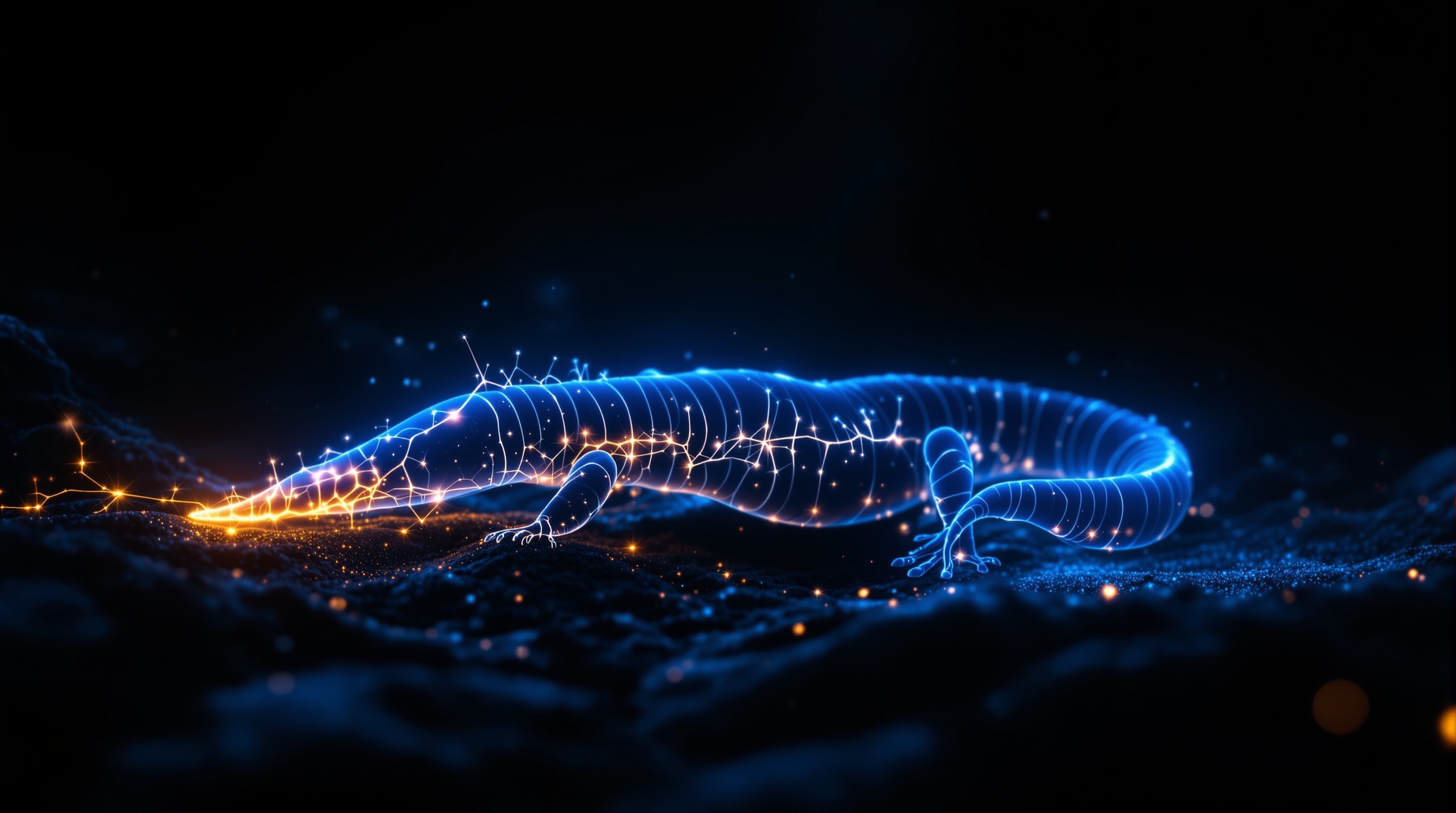
The signal at every wound
The "current of injury" was not Becker's discovery. In the 19th century the German physiologist Emil du Bois-Reymond touched his galvanometer to a cut and watched the needle move: damaged tissue carries a measurable electrical potential. The reason is now textbook — intact skin and epithelia pump ions to maintain a voltage across themselves, and when a wound breaches that barrier, current leaks out at the break, leaving the injured site electrically negative relative to its surroundings. That a wound generates its own voltage is established and uncontroversial.
What was open — and what Becker, working at SUNY Upstate Medical Center and the Syracuse Veterans Administration Hospital, set out to settle — was its meaning. Was the injury current merely a passive leak from broken cells, draining away as they died? Or was it an active control signal, part of how the body decides whether to scar over a wound or rebuild what was lost? The difference is everything. A leak is bookkeeping. A signal is instruction.
Salamanders, frogs, and the reversal
Becker's most rigorous work was comparative, and it turned on a gift of nature: a salamander can regrow an amputated limb, perfectly, bones and nerves and all — while an adult frog, its close evolutionary cousin, cannot. If the injury current is part of the regeneration machinery, then the two animals should differ not just in outcome but in their electrical signature at the stump. So Becker amputated forelimbs in both and tracked the voltage over the following weeks.[1]
Both species began near a slightly negative resting potential and, within about a day of amputation, swung sharply positive. Then their paths split. In the non-regenerating frog, the positive potential simply faded as the stump scarred over and the story ended. In the regenerating salamander, the potential did something remarkable: it reversed, driving back to a strong negative value that peaked around a week and a half after amputation — exactly when the blastema, the mound of dedifferentiated cells that rebuilds the limb, took shape.[1] The crucial detail is the timing: that negative swing arrived long after the originally injured cells had died and cleared. It could not be their passive leak. Something living was actively driving the current — and it appeared precisely where, and when, regeneration began.[2]
This reproducible difference in bioelectric signature between a regenerator and a non-regenerator is Becker's genuine, durable science. He had shown that the electrical environment of a wound is not uniform background hum; it carries a pattern that tracks the body's decision to rebuild.
The salamander does not regrow its limb in spite of the wound's electricity. It regrows the limb, in part, by reading it. — after Becker, J Bone Joint Surg, 1961
Trying to make a mammal regenerate
Measuring a correlation is one thing; proving cause is another. If the negative current accompanies regeneration, Becker reasoned, then supplying it might coax regeneration where it normally fails. With his collaborator Joseph Spadaro, he amputated the forelimbs of rats — mammals that, like frogs, normally just scar — and delivered tiny direct currents to the stumps. The untreated limbs healed over as expected. The stimulated ones did something more: they produced partial regenerative responses — blastema-like tissue, with new growth of bone, cartilage, and other elements beyond what a scar contains.[3]
This is the hinge of the whole story, and it must be told with both halves intact. The mammalian result was real — an electrical nudge shifted a non-regenerating animal partway toward regeneration. It was also partial and preliminary: a sprout of organized tissue, not a regrown paw. It has never translated into limb regeneration in humans, and later groups revisiting the model found the effects modest and hard to extend. Becker had opened a door and shown there was a room behind it. He had not walked through. Honoring both facts at once — the genuine opening and the unfinished crossing — is the whole discipline of reading a pioneer well.
The part that became medicine
Becker's ideas did not stay in the salamander tank. His amphibian work pointed to electricity as a genuine regulator of bone repair,[2] and that thread — pulled further by Becker, by Andrew Bassett, and by others — matured into something rare for a "bioelectric" idea: real, regulated clinical technology. Electrical bone-growth stimulators, devices that apply currents or pulsed electromagnetic fields to stubborn fractures and failed spinal fusions, are FDA-cleared and used in orthopedics today, with controlled trials supporting reduced rates of radiographic nonunion. This is the established descendant of Becker's question — the place where "the body is electrical" stopped being a slogan and became a tool a surgeon can prescribe.
Silver, current, and a side door
One more branch deserves naming, because it shows how a careful experimentalist's work spreads sideways into use. Becker and Spadaro found that a silver electrode under a weak direct current is strongly antibacterial — the current electrochemically releases silver ions that suppress microbial growth.[4] That finding fed into a lineage of silver-based antimicrobial dressings and wound-care research that outlived the controversy around his bigger claims. It is a quiet reminder that Becker, whatever one makes of his grander theories, was first a meticulous measurer who produced results others could build on.
- Step 1 · The woundA voltage appearsBreaching the skin's ion barrier leaks current at the injury, leaving the site electrically negative — the current of injury, known since du Bois-Reymond.
- Step 2 · The comparisonRegenerator vs. scarrerSalamander and frog stumps both swing positive after amputation, then diverge — only the salamander's reverses to negative.[1]
- Step 3 · The timingThe signal builds the blastemaThe negative peak arrives ~1.5 weeks in, as the regeneration blastema forms — too late to be passive cell-death leak.[2]
- Step 4 · The interventionApplied current, partial regrowthSmall DC currents on rat stumps yield partial blastema-like tissue and new bone/cartilage — real but incomplete.[3]
- Step 5 · The descendantBone healing, made clinicalThe bone-repair thread matured into FDA-cleared electrical bone-growth stimulators — the established medicine downstream of the idea.
Established: the current of injury is real and measurable; bioelectric signals genuinely participate in healing and regeneration; electrical bone-growth stimulation is real, FDA-cleared clinical technology; the silver-electrode antibacterial effect is replicated (Spadaro et al. 1974). Historical / preliminary: Becker's salamander measurements were sound (Becker 1961; Becker & Murray 1970), but his attempts to induce mammalian limb regeneration with applied current yielded only partial results (Becker & Spadaro 1972) that have never reached human application. Unproven / contested: the sweeping "body-wide DC control system" framework of The Body Electric, and especially Becker's later advocacy about power-line and environmental EMF health hazards, are not settled science — large reviews have not confirmed the hazards he warned of. Tesla BioLights makes no claim to influence the current of injury, accelerate healing, regenerate tissue, or treat any condition — broadband wellness-experiential modality; this is history of science, not a device benefit.
The Body Electric, and the contested edge
In 1985, Becker and the science writer Gary Selden published The Body Electric: Electromagnetism and the Foundation of Life, the book that made his regeneration research famous and that still draws readers into bioelectricity. It also advanced a far larger thesis: a body-wide direct-current control system, seated partly in the cells around our nerves, governing growth and repair. The measured currents under that thesis are real. The grand unifying framework built on top of them is not established science — it is a bold synthesis that reached past its evidence, much as Burr's L-field did a generation earlier. Becker later became a vocal warner about the health hazards of power-line and ambient electromagnetic fields; that advocacy remains contested and unsettled, and belongs in any honest account as his position, not as consensus.
The rigorous modern inheritor of Becker's central intuition is the same one we met with Burr: Michael Levin's developmental bioelectricity, which treats membrane-voltage patterns as an instructive layer of morphogenetic control and can experimentally redirect what a regenerating animal builds.[5] It is Becker's question — can the electrical signal command the form? — asked again with the molecular tools he never had, and answered, carefully, yes-in-part.
Why Becker belongs in this Journal
Becker is the second pioneer in this Journal's bioelectric arc, and he sharpens the lesson Burr began. Both men found something genuinely real in the electricity of living things, and both reached past it toward a grander theory the evidence could not yet hold. The difference is that Becker also left behind something you can hold in your hand: a bone-growth stimulator in an orthopedic clinic, a silver dressing on a wound. That is the shape of honest science — a real signal, an over-grand story, and a durable tool that survives the sorting.
So why does a light company tell it? Not to claim his results. The S.E.A.D. System does not heal wounds, does not regenerate tissue, does not stimulate bone, and is not a medical device; to say otherwise would be a medical claim, and we make none. Becker belongs here because he is a founding figure in the honest study of the body as an electrical system — the same intellectual neighborhood, mapped carefully, with the boundary between proven, partial, and contested drawn in bright ink. The fuller map lives in the Biofield Research Hub.
Quick answers
What is the "current of injury"?
The small DC voltage at a wound, first measured by du Bois-Reymond in the 1800s. Intact skin maintains a voltage; a wound breaks it, leaking current and leaving the site electrically negative. The phenomenon is established. Becker's question was whether it's a passive leak or an active healing signal.
What did Becker actually prove?
That a regenerating salamander and a non-regenerating frog differ in their stump bioelectric signature: both swing positive after amputation, but only the salamander reverses to a strong negative as the regeneration blastema forms (Becker 1961; Becker & Murray 1970). The timing rules out passive cell-death leak.
Did he make mammals regrow limbs?
Only partially, in rats, with applied DC current — blastema-like tissue and some new bone/cartilage, not a regrown limb (Becker & Spadaro 1972). Real but preliminary, and never translated to humans.
Did any of it become real medicine?
Yes — electrical bone-growth stimulation for fracture nonunion and failed fusions is FDA-cleared clinical technology, downstream of Becker's bone-repair work, and his silver-electrode finding fed silver-based antimicrobial wound care.
Does Tesla BioLights claim any of this?
No. It makes no claim to influence wound currents, accelerate healing, regenerate tissue, stimulate bone, or treat any condition. It is a broadband wellness-experiential modality. This essay is history of science, with the honest boundary drawn at every step.
Tomorrow on the Journal
Day 40 — Björn Nordenström and the Biologically Closed Electric Circuits. The Swedish radiologist who argued the body runs standing electrical circuits through blood vessels and tissue, and pioneered electrochemical treatment of tumors — the next pioneer in the bioelectric lineage, told with the same honest boundary.
Bioelectric Pioneers series · Burr · Becker · Nordenström · Biofield Hub →
References
- Becker RO. The bioelectric factors in amphibian-limb regeneration. J Bone Joint Surg Am. 1961;43-A(5):643-656. PMID 14448529. The salamander-vs-frog stump-potential comparison and the regeneration polarity reversal.
- Becker RO, Murray DG. The electrical control system regulating fracture healing in amphibians. Clin Orthop Relat Res. 1970;73:169-198. PMID 5479774. Electricity as a regulator of bone repair.
- Becker RO, Spadaro JA. Electrical stimulation of partial limb regeneration in mammals. Bull N Y Acad Med. 1972;48(4):627-641. PMID 4503923; PMC1806700. Applied DC current yields partial regenerative tissue in rats.
- Spadaro JA, Berger TJ, Barranco SD, Chapin SE, Becker RO. Antibacterial effects of silver electrodes with weak direct current. Antimicrob Agents Chemother. 1974;6(5):637-642. PMID 15825319; PMC444706. Electrochemically released silver ions as the antibacterial agent.
- Levin M. Bioelectric signaling: Reprogrammable circuits underlying embryogenesis, regeneration, and cancer. Cell. 2021;184(8):1971-1989. PMID 33826908. The rigorous modern descendant — voltage patterns as instructive morphogenetic control.