
Björn Nordenström and the Biologically Closed Electric Circuits
The pioneers of bioelectricity are usually outsiders — and then there is Björn Nordenström. Not a fringe figure but a pillar of the establishment: a Karolinska radiologist whose needle-biopsy technique you may have benefited from, and a president of the Nobel Assembly — the body that awards the Nobel Prize in Medicine. When a man with those credentials spends his later years arguing that the body runs hidden electrical circuits, the honest response is neither to genuflect nor to scoff, but to do the harder thing: separate, carefully, where his accepted science ends and his speculation begins.
The credentialed insider
Björn E. W. Nordenström (1919–2006) spent his career at the Karolinska Institute in Stockholm, where he became professor and head of diagnostic radiology. His mainstream legacy is secure and entirely uncontroversial: he was a pioneer of percutaneous fine-needle biopsy of the lung, developing in the 1960s the techniques that let clinicians sample a suspicious chest lesion through the skin with a thin needle, rather than opening the chest. Those methods are in everyday diagnostic use to this day. This was not a man at the margins of medicine — he was, for roughly two decades, a member of the Nobel Assembly at the Karolinska Institute, and served as its President in 1985.
That biography matters, because it sets the terms for reading what followed. When an eminent, rigorously trained diagnostician advances an unconventional theory, the lazy moves — reverence on one side, ridicule on the other — both fail. The work has to be weighed on its merits. And weighed honestly, Nordenström's later work splits cleanly into a real phenomenon, a contested therapy, and a grand theory the rest of medicine never adopted.
A pattern in the X-rays
It began, fittingly for a radiologist, with an image. Studying chest radiographs of lung tumors, Nordenström kept noticing fine radiating structures — a kind of corona — around the lesions. Where most read these as incidental, he came to suspect they reflected something active: electrical activity in and around the tissue. From that seed grew a sweeping idea, laid out in his 1983 book Biologically Closed Electric Circuits.[1]
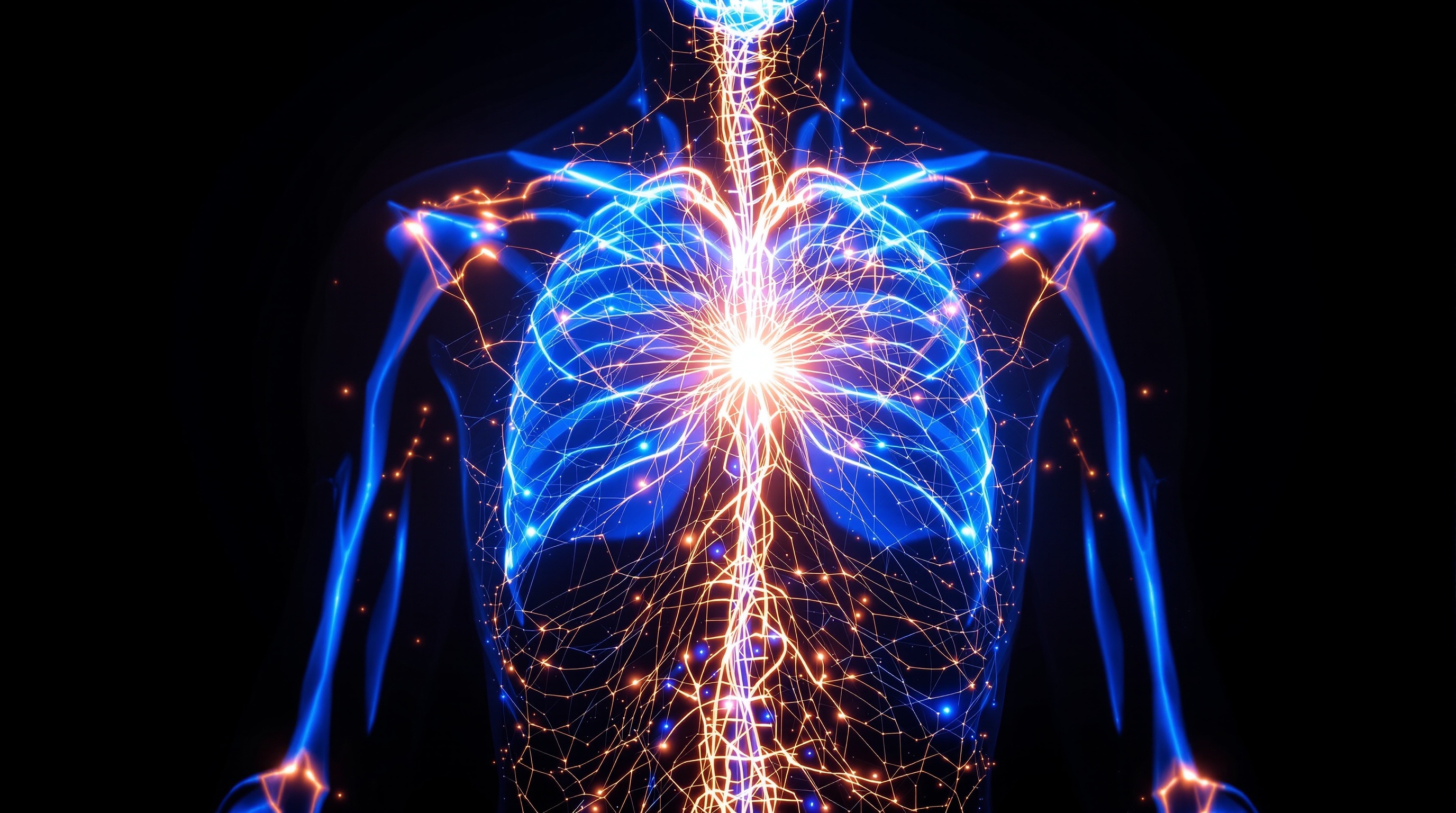
The proposal was bold. Alongside the familiar circulatory system, Nordenström argued, the body operates additional closed electrical circuits. In his model, blood vessels act as insulated cables; the blood within them, the surrounding tissue, the interstitium, and capillary walls serve as conductors and ion-selective membranes. The circuits are driven, he said, by voltage differences that arise from injury, inflammation, infection — and, most provocatively, from the electrical polarity that develops around tumors. Stitched together, these formed what he called a genuine, ongoing regulatory network: an additional circulatory system, electrical rather than fluid.
The body, Nordenström insisted, is wired as well as plumbed. The harder question is how much of that wiring is real circuitry — and how much is a brilliant diagnostician seeing pattern where biology has not confirmed one. — on Biologically Closed Electric Circuits, 1983
From theory to electrodes
Nordenström did not stop at description; like Becker before him, he tried to intervene. If a tumor carries an electrical polarity, he reasoned, then a current might be turned against it. He pioneered electrochemical treatment (EChT) — inserting electrodes directly into a tumor and passing a direct current through it. He reported clinical attempts, notably on lung tumors, observing that tissue responded differently to the positive anode than to the negative cathode.[2]
The mechanism later researchers identified is not mystical but straightforwardly electrochemical: a sustained direct current drives extreme pH changes at the electrodes — strongly acidic at the anode, strongly basic at the cathode — and that local chemical swing destroys nearby cells. It is, in effect, a form of electrolytic ablation.[4] The technique was taken up on a far larger scale in China, where Yu-Ling Xin and colleagues reported treating large numbers of patients and published clinical case series, including on lung cancer.[3]
Here the honesty has to be firm, especially because the subject is cancer. The reported results are intriguing and the physics is real, but the EChT evidence — above all the very large Chinese series — consists overwhelmingly of uncontrolled case series, not the randomized controlled trials that Western regulators and oncologists require. It is biologically plausible and historically important; it is not validated standard care, and nothing about it is a treatment you should seek from anyone outside a rigorous clinical setting.
What modern medicine did accept
The broad intuition beneath all of this — that electric fields can act on tumor cells — did eventually produce a rigorous, regulated, mainstream therapy, though by a different route than Nordenström's needles. Tumor Treating Fields (TTFields, marketed as Optune) deliver low-intensity alternating electric fields through the scalp to disrupt dividing glioblastoma cells; its pivotal randomized trial showed a survival benefit, and it is FDA-approved.[5] That is the legitimate modern anchor for "electricity affects tumors" — a controlled, approved oncology treatment, distinct from Nordenström's unvalidated EChT and entirely separate from his speculative circuit theory. The kernel was real; the rigorous form of it arrived through the front door of evidence-based medicine.
- Step 1 · ObservationA corona in the X-rayNordenström sees radiating structures around lung tumors and suspects electrical activity in the tissue.[1]
- Step 2 · TheoryBiologically Closed Electric CircuitsHe proposes vessels as cables and tissue as conductors — an additional electrical circulatory system driven by injury and tumor polarity.[1]
- Step 3 · InterventionElectrochemical treatmentElectrodes in a tumor pass DC current; pH swings at the poles ablate tissue. Tried on lung tumors, later scaled in China.[2]
- Step 4 · The evidence gapCase series, not trialsEChT results are largely uncontrolled — promising and plausible, but not validated by randomized trials, and outside standard care.[3]
- Step 5 · The accepted descendantFDA-approved field therapyTumor Treating Fields reach the clinic by the rigorous route — a controlled trial, regulatory approval, real oncology.[5]
Established: Nordenström was a legitimate, eminent radiologist whose needle-biopsy work is accepted, lasting medicine; tissues carry real electrical potentials, injury currents are documented, and tumors do show altered electrical properties; electrolytic ablation is a real mechanism; and electric-field cancer therapy has a rigorous, FDA-approved form in Tumor Treating Fields (Stupp 2017). Preliminary / contested: electrochemical treatment (EChT) of tumors rests overwhelmingly on uncontrolled case series (Nordenström 1989; Xin 1997; reviewed in Nilsson 2000) — plausible but not validated by randomized trials, and not standard care. Unproven / speculative: the grand "Biologically Closed Electric Circuits" as a whole additional circulatory and regulatory system is Nordenström's own framework and is not established mainstream physiology. Tesla BioLights is NOT a medical device and makes no claim to treat, cure, or prevent tumors, cancer, or any disease — this is history of science, not a treatment claim. For any medical concern, consult a licensed physician.
Why Nordenström belongs in this Journal
Three pioneers now, one lesson sharpening each time. Burr measured the body's fields and theorized a blueprint. Becker measured the wound's current and tried to drive regeneration. Nordenström, the most credentialed of the three, mapped electrical circuits onto the vasculature and turned current against tumors. Each found something genuinely real in the body's electricity; each built a theory larger than the evidence could hold; and in each case the durable, rigorous descendant arrived later, by the careful road. That repeating shape — real signal, over-grand story, eventual disciplined science — is the history of bioelectricity, and it is exactly why this Journal insists on drawing the three apart every time.
So why does a light company publish a piece that touches cancer? Precisely to model the boundary. The S.E.A.D. System is not a medical device; it does not treat tumors, cancer, or any disease, and to suggest otherwise would be both false and harmful. Nordenström belongs here as history — a serious scientist in the lineage of bioelectric thought — and as a discipline: the reminder that the right response to a bold electrical claim about the body is careful sorting, not belief. The fuller map lives in the Biofield Research Hub.
Quick answers
Who was Björn Nordenström?
A Swedish radiologist at the Karolinska Institute (1919–2006), pioneer of percutaneous lung needle-biopsy, and a member and 1985 President of the Nobel Assembly. Late in his career he proposed an electrical theory of the body — "Biologically Closed Electric Circuits" — and pioneered electrochemical tumor ablation.
What are Biologically Closed Electric Circuits?
His 1983 theory that the body runs additional closed electrical circuits — vessels as cables, tissue as conductors — driven by injury and tumor polarity. The electrical phenomena he cited are real; the grand "additional circulatory system" framework is his own and is not established physiology.
What was electrochemical treatment (EChT)?
Passing direct current through electrodes placed in a tumor; pH swings at the electrodes ablate tissue. Tried on lung tumors and scaled in China — but the evidence is mostly uncontrolled case series, not validated by randomized trials, and it is not standard care.
Did mainstream medicine accept any of it?
The general idea that electric fields affect tumor cells has a rigorous, FDA-approved descendant in Tumor Treating Fields (Optune), shown to extend survival in glioblastoma (Stupp 2017) — distinct from Nordenström's unvalidated EChT and his speculative circuit theory.
Does Tesla BioLights treat cancer or any disease?
No. It is not a medical device and makes no claim to treat, cure, or prevent tumors, cancer, or any condition. This essay is history of science with a strict boundary. For any medical concern, consult a licensed physician.
Bioelectric Pioneers series · Burr · Becker · Nordenström · Biofield Hub →
Tomorrow on the Journal
Day 41 — Albert Szent-Györgyi and the Electronic Theory of Life. The Nobel laureate who discovered vitamin C and then argued that life runs on the movement of electrons through proteins — the founder of "bioelectronics," and the next pioneer in the lineage, told with the same honest boundary.
References
- Nordenström BEW. Biologically Closed Electric Circuits: Clinical, Experimental and Theoretical Evidence for an Additional Circulatory System. Stockholm: Nordic Medical Publications; 1983. The foundational BCEC monograph.
- Nordenström BE. Electrochemical treatment of cancer. I: Variable response to anodic and cathodic fields. Am J Clin Oncol. 1989;12(6):530-536. PMID 2556014. Nordenström's primary EChT report.
- Xin Y, Xue F, Zhao F. Effectiveness of electrochemical therapy in the treatment of lung cancers of middle and late stage. Chin Med J (Engl). 1997;110(5):379-383. PMID 9594307. Large uncontrolled Chinese clinical series.
- Nilsson E, von Euler H, Berendson J, et al. Electrochemical treatment of tumours. Bioelectrochemistry. 2000;51(1):1-11. PMID 10790774. Review of the electrolytic mechanism and evidence.
- Stupp R, Taillibert S, Kanner A, et al. Effect of Tumor-Treating Fields plus maintenance temozolomide vs maintenance temozolomide alone on survival in patients with glioblastoma: a randomized clinical trial. JAMA. 2017;318(23):2306-2316. PMID 29260225; PMC5820703. The pivotal EF-14 trial behind FDA-approved TTFields.