
Interoception: The Sense of the Body's Inner State
For two days we have watched signals travel up: the vagus carrying the body's report to the brain, heart rate variability tracing that traffic in the pulse. But a signal arriving is not the same as a signal felt. What does the brain do with the flood of information streaming up from the heart, the lungs, the gut, the skin? It builds a sense — the one you almost never name, because it is not a sense of the world but a sense of you. The warmth of a blush, the tightness before you speak, the hollow of hunger, the flutter of a racing heart: all of it is a perception, as much as sight or sound. It is called interoception, the least-known of the senses, and it is the ground from which the feeling of being alive — and, tomorrow, emotion itself — is most likely built.
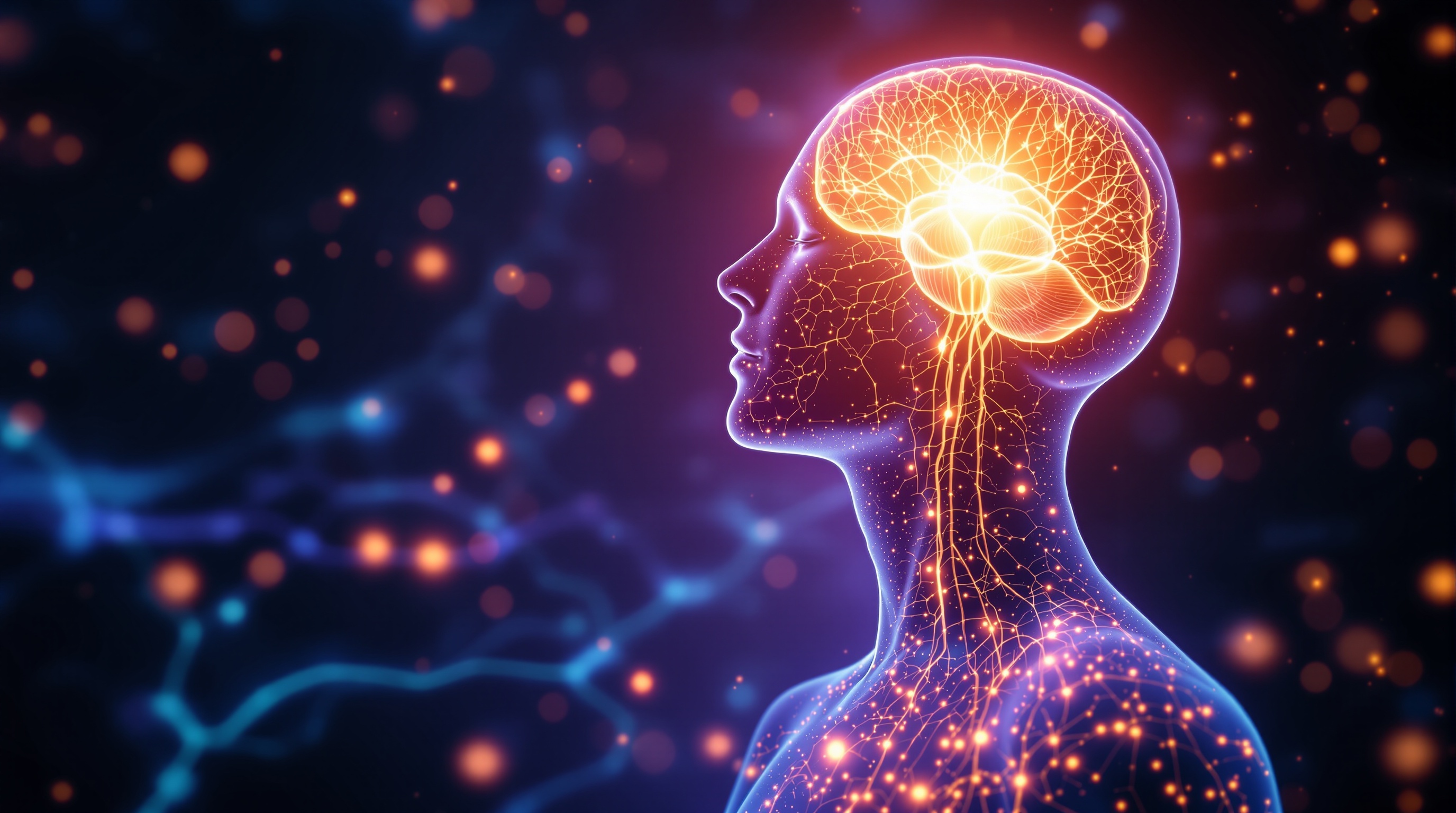
The sense that points inward
We are taught there are five senses, all of them aimed outward — sight, hearing, touch, smell, taste. But that list, traceable rhetorically all the way to Aristotle, left out the whole interior. In 1906, the great physiologist Charles Sherrington — whose name we met earlier in this series — carved the sensory world into three provinces: exteroception (the outside world), proprioception (the position of the limbs), and interoception — the receptors of the interior, the viscera.[1] His original meaning was narrow, centered on the gut. The modern, expanded sense — "the sense of the physiological condition of the body" — belongs to the neuroanatomist A.D. "Bud" Craig, who in a pair of landmark papers redrew interoception as the brain's representation of the whole homeostatic state of the flesh: cardiac, respiratory, visceral, thermal, metabolic, and the "how is the tissue doing" signals of pain and temperature.[2]
How does that information reach the brain? By two great ascending streams. The first is the one we have been following: the vagus and other cranial visceral afferents, carrying the viscera's report up to the nucleus tractus solitarius in the brainstem. The second is Craig's special emphasis — a spinal pathway in which small-diameter fibers reporting the status of every tissue synapse in lamina I of the spinal cord's dorsal horn and ascend the spinothalamic tract. Both streams pass through the thalamus and converge on one destination: the insular cortex, folded deep in the side of the brain. And here Craig proposed the idea that reframed the field. The insula holds a gradient: a primary map of the body's state in its posterior and middle parts, which is then re-represented and integrated in the anterior insula — the place he tied to subjective feeling, to awareness, to what he memorably called "the material me."[3]
This system constitutes a representation of "the material me", and might provide a foundation for subjective feelings, emotion and self-awareness. — A. D. Craig, Nature Reviews Neuroscience (2002)
Three things we mean by "in touch with your body"
Here the honest science demands a distinction that almost every popular account blurs. "Being in tune with your body" is not one thing but at least three, and they come apart. In an influential 2015 framework, Sarah Garfinkel and colleagues separated interoception into accuracy, sensibility, and awareness.[4] Interoceptive accuracy is your objective performance on a test — can you actually detect your own heartbeats? Interoceptive sensibility is your self-reported tendency to notice and trust bodily signals, the thing a questionnaire measures. And interoceptive awareness is metacognitive: does your confidence track your accuracy — do you know when you are right? The three dissociate. A person can score high on the questionnaire ("I am extremely attuned to my body") and poorly on the objective test. This is the single most important piece of construct hygiene in the field, and its casualty is a great deal of wellness marketing: a strong feeling that you are in touch with your body is not evidence that you actually are.
That distinction bites hardest at the field's most famous tool: the heartbeat-counting task. Introduced by Rainer Schandry in 1981, it asks a person to silently count their own heartbeats over an interval, and scores them against the true count.[5] It is simple, popular — and deeply contested. The trouble is that people partly estimate: they count from what they believe their heart rate to be, not from what they actually sense. Ring and Brener showed that counted rates track people's beliefs about their heart rate, and in 2018 Zamariola and colleagues argued that the standard accuracy score is not a valid index of interoceptive accuracy at all.[5] Counting, it turns out, is not the same as detecting. The measurement itself is under active dispute — which is exactly why a heartbeat-counting number should never be handed to someone as the truth about their inner sense.
- Step 1 · TransduceThe body registers its stateReceptors across the viscera and tissues read internal condition — cardiac and baroreceptor afferents, chemo- and mechanoreceptors of lung and gut, thermoreceptors, metabolic and nociceptive fibers.
- Step 2 · AscendTwo streams carry it upSignals ride the vagus and cranial visceral afferents to the nucleus tractus solitarius, and spinal lamina I neurons up the spinothalamic tract — the small-fiber "how is the tissue doing" channel.[2]
- Step 3 · RelayThrough the thalamus to a mapBoth streams pass through thalamic relays; the body's condition becomes an organized map rather than scattered signals.
- Step 4 · RepresentThe insula reads the bodyThe map reaches the posterior and mid insula and is re-represented in the anterior insula, integrated with attention, context, and prediction (with the anterior cingulate as action partner).[3]
- Step 5 · FeelFrom signal to the "material me"The brain interprets and predicts these signals; the result is a felt bodily state that grounds homeostatic drive and — on the Craig line — the raw material of emotion. (Continued tomorrow.)
The honest ledger — a real sense, and its wellness counterfeit
Interoception is one of the most genuinely exciting frontiers in neuroscience, which is exactly why it needs the discipline of the three tiers. Established: interoception is a real afferent sense, with defined pathways and a clear cortical home in the insula; interoceptive signals inform emotion, homeostatic regulation, and the bodily sense of self; and people genuinely differ, along the three measurable dimensions. It is also true that altered interoception is associated with anxiety, depression, and eating disorders in the research literature — and that word, associated, is doing precise work: it means a correlation observed, not a cause proven.
Frontier: whether interoception-focused approaches — including the interoceptive-exposure work studied within anxiety research — lead to reliable, generalizable outcomes is an open, active question, not a settled result. So is the predictive-processing account, the influential idea (associated with Anil Seth, Lisa Feldman Barrett, and Hugo Critchley) that the brain does not passively read its bodily signals but actively predicts them, and that feelings arise from this "interoceptive inference." It is a powerful and productive theory. It is not proven fact, and honest writing keeps it in the conditional.
Overclaimed: and here the counterfeits need naming. The claim that you can "train your interoception to heal trauma, anxiety, or disease," or that "reconnecting with your body" cures a condition, runs far past the evidence and into the territory of medical overreach. Handing someone a heartbeat-counting score as the truth about their "body intelligence" misuses a confounded measurement. Collapsing the three constructs into a single "how in touch with your body are you" number erases the distinction the science fought to establish. And the pop-cultural promise that a "gut feeling" should always be trusted gets the physiology backwards: interoceptive signals can be noisy, biased, and misread. Interoception is a real sense — one of the most important we have. It is not psychic body wisdom, and it does not come with a warranty of accuracy.
Established: INTEROCEPTION is a real afferent sense — the brain's representation of the body's physiological condition (heartbeat, breath, gut, temperature, air hunger, pain). Charles SHERRINGTON coined "interoceptive" (1906); A.D. "Bud" CRAIG broadened it to "the sense of the physiological condition of the body" and mapped the pathways (vagal afferents → nucleus tractus solitarius; spinal LAMINA I → spinothalamic tract) up to the INSULAR CORTEX, with a posterior→anterior gradient he tied to feeling and "the material me" (Craig 2002, 2009). Interoceptive ACCURACY (test performance) ≠ SENSIBILITY (self-report) ≠ AWARENESS (metacognition) — three dissociable dimensions (Garfinkel et al. 2015). Interoceptive signals ground emotion and homeostasis; people genuinely differ; altered interoception is ASSOCIATED with anxiety/depression/eating disorders (association, not proven causation). Frontier (real, unsettled): interoception-based approaches and interoceptive-exposure in anxiety research; the PREDICTIVE-PROCESSING / interoceptive-inference account (Seth, Barrett, Critchley); the VALIDITY of the heartbeat-counting task is actively debated (Schandry 1981 origin; Ring & Brener — counts track BELIEFS about heart rate; Zamariola et al. 2018 — the standard score is problematic; counting ≠ detection). Rejected / overclaimed: "train your interoception to heal trauma/anxiety/disease" and "body-awareness cures"; treating a confounded heartbeat-counting score as true interoceptive ability; collapsing accuracy/sensibility/awareness into one "in touch with your body" number; "always trust your gut" as a physiological law. Interoception is a real sense, not infallible body wisdom. Tesla BioLights makes no medical claims.
Quick answers
What is interoception?
The sense of the body's internal physiological state — the brain's readout of heartbeat, breathing, gut, temperature, air hunger, and more. Where the five classic senses point outward and proprioception tracks the limbs, interoception points inward at the condition of the flesh. Sherrington coined the term (1906); Craig broadened it to "the sense of the physiological condition of the body."
Accuracy vs. sensibility vs. awareness — what's the difference?
Three dissociable dimensions (Garfinkel et al. 2015). Accuracy = objective test performance (can you detect your heartbeats?). Sensibility = self-reported tendency to notice/trust bodily signals (a questionnaire). Awareness = metacognition, whether your confidence tracks your accuracy. A person can be high on one and low on another — so feeling "in tune with your body" isn't evidence of objective accuracy.
Where in the brain is interoception represented?
Signals ascend via the vagus to the nucleus tractus solitarius and via spinal lamina I up the spinothalamic tract, and through the thalamus converge on the insular cortex. Craig proposed a gradient: a primary map in the posterior/mid insula re-represented in the anterior insula, which he linked to subjective feeling and self-awareness — "the material me."
Is the heartbeat-counting test a good measure?
It's the most used test, but its validity is contested. People partly count from what they believe their heart rate is, not what they sense (Ring & Brener), and Zamariola et al. (2018) argued the standard accuracy score isn't a valid index. Counting isn't detection. A heartbeat-counting number shouldn't be treated as the truth about someone's inner sense.
Can you "train your interoception" to heal?
Interoception is a genuine, active research area, and altered interoception is associated with anxiety, depression, and eating disorders (association, not proven cause). But "train your interoception to heal trauma or disease" and "body awareness cures" run far ahead of the evidence. Interoception isn't infallible "body wisdom" either — signals can be noisy and misread. Nothing here is medical advice.
Does Tesla BioLights make medical claims about this?
No. Zero medical claims. Interoception is a real afferent sense that grounds emotion and homeostasis — precisely why "train your interoception to heal" products and the misuse of a confounded heartbeat-counting score overreach. Association is not causation; a proxy is not a diagnosis. Nothing here validates any product.
Bioelectric Mechanisms · The memory · The ecosystem · The wanderer · The rhythm · The inner sense · Biofield Hub →
Tomorrow on the Journal
Day 80 — Emotion: How the Body Makes a Feeling. If interoception is the body's inner sense, emotion is one of the great things the brain builds from it. Tomorrow: the 140-year argument from William James ("we feel sorry because we cry") through Cannon, Schachter and Singer, and Damasio to Lisa Feldman Barrett's constructed emotion — and why "read your true feelings from your face" AI, microexpression lie detection, and "trapped emotions in the tissues" are the overreach the science does not support.
References
- Sherrington CS. The Integrative Action of the Nervous System. New York: Charles Scribner's Sons; 1906. Coined "interoceptive"/"interoceptors" (with exteroceptive and proprioceptive). Full text: Internet Archive. Centenary appraisal: Brain. 2007;130(4):887. PMID 17223135.
- Craig AD. How do you feel? Interoception: the sense of the physiological condition of the body. Nature Reviews Neuroscience. 2002;3(8):655–666. DOI 10.1038/nrn894. The lamina I / spinothalamic / insular interoceptive system.
- Craig AD. How do you feel — now? The anterior insula and human awareness. Nature Reviews Neuroscience. 2009;10(1):59–70. DOI 10.1038/nrn2555. The anterior insula as a re-representation and awareness hub — "the material me."
- Garfinkel SN, Seth AK, Barrett AB, Suzuki K, Critchley HD. Knowing your own heart: Distinguishing interoceptive accuracy from interoceptive awareness. Biological Psychology. 2015;104:65–74. DOI 10.1016/j.biopsycho.2014.11.004. PMID 25451381. The accuracy / sensibility / awareness framework.
- The heartbeat-counting task and its critique. Schandry R. Heart beat perception and emotional experience. Psychophysiology. 1981;18(4):483–488. DOI 10.1111/j.1469-8986.1981.tb02486.x. PMID 7267933. Critiques: Ring C, Brener J. Influence of beliefs about heart rate and actual heart rate on heartbeat counting. Psychophysiology. 1996;33(5):541–546. DOI 10.1111/j.1469-8986.1996.tb02430.x. And Zamariola G, et al. Interoceptive accuracy scores from the heartbeat counting task are problematic. Biol Psychol. 2018;137:12–17. DOI 10.1016/j.biopsycho.2018.06.006. PMID 29944964.
- Forward bridge and caution. James W. What is an Emotion? Mind. 1884;os-IX(34):188–205. DOI 10.1093/mind/os-IX.34.188 (interoception as the afferent basis of emotion — see Day 80). Note: mental-health links to altered interoception in the literature are associations, not proven causes; interoception-based interventions remain active research, not established treatments.