
The Vagus Nerve: The Body's Great Wandering Cable
Yesterday the gut talked to the brain, and one of the loudest channels it uses is a single nerve — the longest, most far-flung of them all. Its name is Latin for wandering, because unlike every other cranial nerve it refuses to stay near the head: it leaves the brainstem and roams down through the neck and chest into the belly, brushing the heart, the lungs, the stomach, and most of the gut along the way. We tend to imagine it as the body's brake pedal — the nerve of calm, of "rest and digest." But that picture is almost backwards. Most of its fibers do not carry commands down from the brain at all; they carry information up to it. The vagus is, above all, the great cable by which the body tells the brain how it is doing — and it is also, not by accident, the site of one of the most beautiful experiments in the history of science, and the most oversold nerve in the wellness aisle.
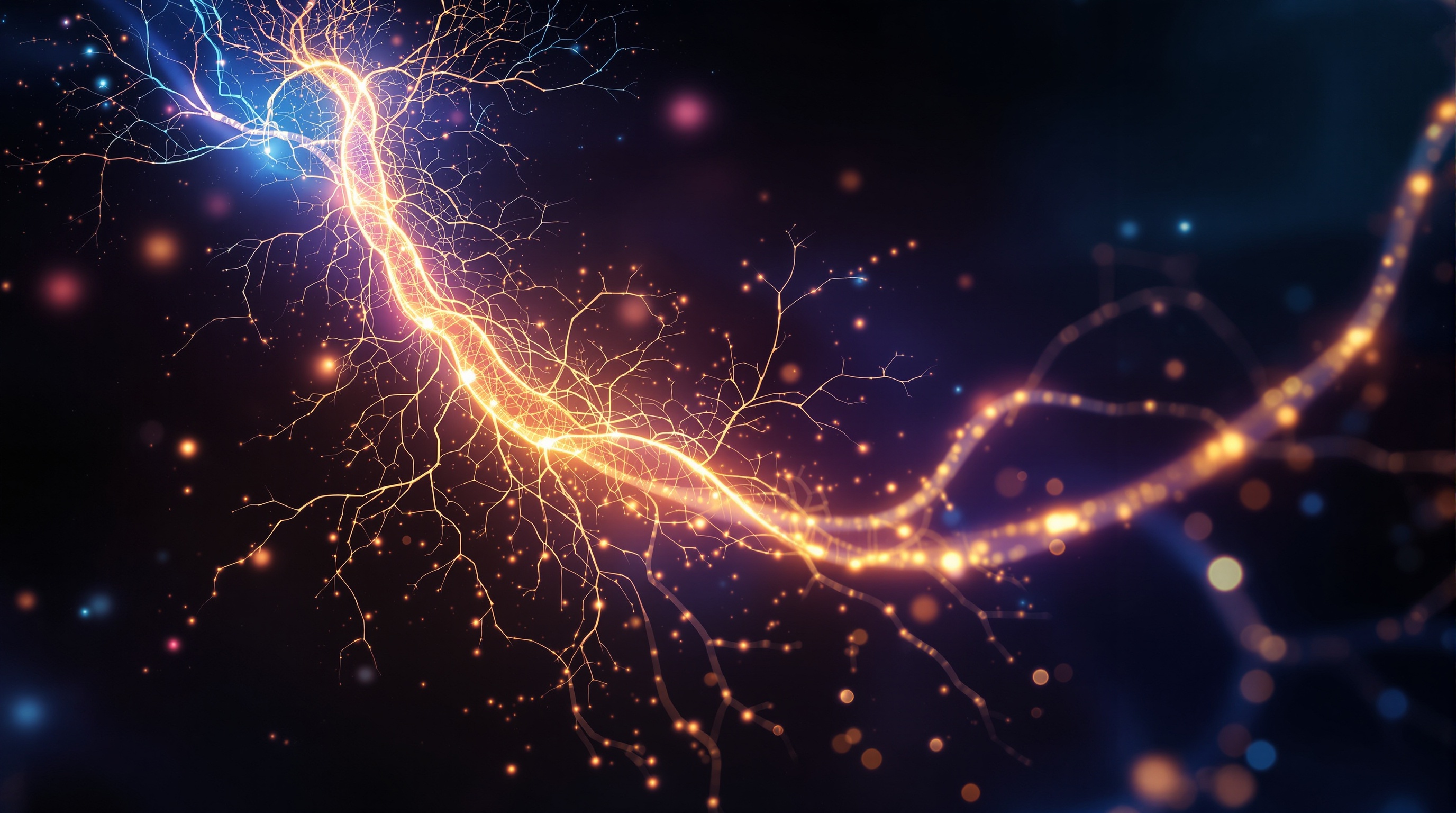
The tenth nerve, and the direction of its traffic
The vagus is the tenth cranial nerve — cranial nerve X — and the dominant nerve of the parasympathetic division of the autonomic nervous system, the branch we shorthand as "rest and digest." It is a mixed nerve: partly motor, mostly sensory. And that word mostly is the fact this whole essay turns on. The vagus is commonly described as roughly four-fifths afferent — on the order of 80 percent of its fibers carry signals up from the body to the brain, while only about a fifth are efferent motor commands heading the other way.[2] Gut fullness, blood chemistry, the stretch of the lungs, the state of the heart — all of it streams upward along the vagus into the brainstem. So the intuitive image of the vagus as a brake pedal the brain presses is almost inverted: far more of its traffic is the body reporting to the brain than the brain issuing orders. It is the body's primary interoception cable.
All that inbound information has to land somewhere, and it lands in three small clusters of neurons in the medulla. The nucleus tractus solitarius is the great inbound terminal — where the vagus's sensory fibers arrive and are read. The dorsal motor nucleus sends parasympathetic fibers out to the abdominal viscera, the secretomotor side of "rest and digest." And the nucleus ambiguus supplies, among other things, the fast cardio-inhibitory fibers that slow the heart. When the efferent side does speak, it speaks in a single chemical word: acetylcholine, released at the target organs to slow the heartbeat, and to drive the churn and secretion of digestion. Hold onto that molecule — because it is where the history begins.
Vagusstoff: the first proof that nerves speak in molecules
At the start of the twentieth century, a fierce argument divided physiology: when a nerve reaches an organ, does it pass its message by a leaping spark of electricity, or by releasing a chemical? In 1921, Otto Loewi settled it with an experiment of almost unbelievable simplicity. He took a frog's heart, still beating in a dish, kept alive by a bath of fluid, with its vagus nerve attached. He stimulated the vagus, and the heart slowed — no surprise. Then he did the thing that made history: he collected the fluid that had bathed that first heart, and dripped it onto a second frog heart that had no nerve attached at all. The second heart slowed too. Something dissolved in the fluid had carried the vagus's command. Loewi named that something Vagusstoff — "vagus substance" — and it was later identified as acetylcholine.[1] It was the first experimental proof of chemical neurotransmission: the discovery that the nervous system talks in molecules. Loewi liked to say the design had come to him in a dream, scrawled on a slip of paper he couldn't read the next morning, returning to him the following night at three a.m. — an account that is charming, his own, and probably a little embellished.[6]
For that discovery, Loewi shared the 1936 Nobel Prize in Physiology or Medicine with Sir Henry Dale, whose work identified the chemistry Loewi's fluid implied. Every antidepressant, every account of how a synapse works, every neurotransmitter you have ever heard named, descends from a slowed frog heart and a few drops of transferred fluid.
…for their discoveries relating to chemical transmission of nerve impulses. — The Nobel Prize in Physiology or Medicine 1936 (Loewi & Dale)
- Step 1 · SenseThe body reports inVagal afferents throughout the heart, lungs, and gut detect the internal state — stretch, chemistry, immune and inflammatory signals.
- Step 2 · UpMost of the cable runs upwardRoughly four-fifths of vagal fibers carry this interoceptive data up to the brainstem, terminating in the nucleus tractus solitarius.[2]
- Step 3 · DecideThe brainstem computes a responseThe solitary nucleus relays to autonomic control centers, which weigh the input and set a parasympathetic response.
- Step 4 · DownAcetylcholine goes outEfferent commands leave via the dorsal motor nucleus (viscera) and nucleus ambiguus (heart), releasing acetylcholine at the targets.
- Step 5 · ActRest and digest — and, perhaps, damp the fireThe heart slows and the gut shifts toward rest-and-digest; and, on the research frontier, cholinergic signaling may reflexively dampen inflammation.[3]
The real medicine, the live frontier, and the overreach
Because the vagus touches the heart, the gut, and — through the brainstem — mood and inflammation, it has become a magnet for both serious medicine and serious hype, and the honest task is to keep the three tiers apart. Start with what is genuinely established as medicine. Implanted vagus nerve stimulation — VNS, a surgically placed device that delivers electrical pulses to the nerve in the neck — is a real, regulated therapy. The U.S. FDA approved implanted VNS as an adjunctive treatment for refractory epilepsy in 1997, and for treatment-resistant depression in 2005, each for defined groups of patients who had not responded to standard treatments.[4] Note precisely what that is: a device, implanted in surgery, approved for named indications in people who have exhausted other options. It is not a wellness accessory.
Then the frontier, where the science is real and the conclusions are not yet in. In 2002, Kevin Tracey described the "inflammatory reflex" — the hypothesis, built on animal and translational work, that vagal signaling can reflexively turn down the body's production of inflammatory molecules like TNF, a cholinergic anti-inflammatory pathway.[3] It is influential and actively studied, and its human therapeutic uses remain largely investigational. So does the broader story of gut–brain vagal signaling in mood and appetite that we picked up yesterday — proposed, partly supported, not settled. And so does transcutaneous auricular VNS (taVNS), a non-invasive approach that stimulates a vagal branch at the outer ear: brain-imaging studies show it can plausibly engage central pathways,[5] but the evidence for clinical benefit across conditions is still early, small, and mixed. Promising is not the same as proven, and the honest reader holds both.
And then the overreach, which needs naming. Around that real science has grown a market of consumer "vagus nerve reset" and "tone your vagus" products — ear clips, buzzing gadgets, breathing devices — sold as cure-alls that "reset your nervous system." They borrow the credibility of implanted VNS and the inflammatory-reflex research while making claims that are neither FDA-approved indications nor supported by the trial evidence. There is a real physiological fact underneath the marketing: slow breathing genuinely does shift autonomic balance toward the parasympathetic and raise short-term heart-rate-variability metrics. But a transient, measurable shift in autonomic state is not a durable medical intervention, and conflating the two is exactly the overclaim. The single most useful thing to carry from this essay is a three-way distinction: FDA-approved implanted VNS for specific indications is not the same thing as investigational taVNS, which is not the same thing as an unregulated consumer "vagus" gadget. Collapsing those three is the whole trick.
Established: the vagus is CN X, the principal PARASYMPATHETIC nerve ("rest and digest"), a MIXED nerve that is mostly (commonly cited ~80%) AFFERENT — carrying interoceptive signals UP from heart/lungs/gut to the brainstem (nucleus tractus solitarius), with efferent output via the dorsal motor nucleus and nucleus ambiguus signaling by ACETYLCHOLINE. Otto LOEWI's 1921 frog-heart experiment isolated VAGUSSTOFF (acetylcholine) — the first proof of CHEMICAL NEUROTRANSMISSION; Loewi & Dale, Nobel 1936. Implanted VAGUS NERVE STIMULATION (VNS) is a real, FDA-approved, SURGICALLY IMPLANTED therapy for SPECIFIC indications: refractory epilepsy (1997) and treatment-resistant depression (2005). Frontier (real, unsettled): the cholinergic anti-inflammatory "INFLAMMATORY REFLEX" (Tracey 2002); gut–brain vagal signaling in mood/appetite; and non-invasive TRANSCUTANEOUS AURICULAR VNS (taVNS) — central engagement shown on fMRI, but efficacy evidence early/small/mixed. Rejected / overclaimed: consumer "vagus nerve reset," "tone your vagus" gadgets, ear clips, and breathing devices sold as cure-alls or nervous-system "resets" — not FDA-approved indications, not supported by trial evidence. Slow breathing genuinely shifts autonomic balance and raises short-term HRV, but a transient shift is not a durable medical intervention. "Vagal tone" is INDEXED by HRV — a proxy, not a direct nerve recording (tomorrow's subject). Key distinction: approved implanted VNS ≠ investigational taVNS ≠ unregulated wellness product. Tesla BioLights makes no medical claims.
Quick answers
What is the vagus nerve?
The tenth cranial nerve (CN X) and the dominant nerve of the parasympathetic — "rest and digest" — system. Its name means "wandering": it travels from the brainstem down through the neck and chest into the abdomen, touching the heart, lungs, and gut. It is a mixed nerve that is mostly sensory, signaling to its targets with acetylcholine.
Is the vagus nerve mostly sensory or motor?
Mostly sensory. It is commonly described as roughly four-fifths afferent — about 80% of its fibers carry information up from the body to the brain (gut, lungs, heart, blood chemistry), and only about 20% are efferent motor commands. That is why it is best thought of as the body's main interoception cable, not just a brake pedal.
What was Otto Loewi's Vagusstoff experiment?
In 1921 Loewi stimulated the vagus of an isolated frog heart (it slowed), then transferred that heart's bathing fluid to a second heart with no nerve attached — and the second heart slowed too. A chemical had carried the signal. He named it "Vagusstoff"; it was acetylcholine. It was the first proof of chemical neurotransmission. Loewi shared the 1936 Nobel Prize with Henry Dale.
Is vagus nerve stimulation a real treatment?
Yes, but a specific, regulated, surgically implanted one. Implanted VNS was FDA-approved for refractory epilepsy (1997) and treatment-resistant depression (2005), for defined patient groups. Non-invasive transcutaneous auricular VNS (taVNS) at the ear is a genuine but early research frontier — imaging shows central engagement, but clinical evidence is early and mixed. The two are not the same.
Can I "reset" or "tone" my vagus with a gadget or breathing?
Slow breathing really does shift autonomic balance toward the parasympathetic and raise short-term HRV — that's real. But "vagus reset"/"tone your vagus" gadgets and breathing devices sold as cure-alls overreach: those claims aren't FDA-approved and aren't supported by trial evidence. A transient autonomic shift isn't a durable medical intervention. Approved implanted VNS ≠ investigational taVNS ≠ a wellness product.
Does Tesla BioLights make medical claims about this?
No. Zero medical claims. The vagus is real, its physiology is established, and implanted VNS is genuine regulated medicine for specific indications — precisely why the "reset your vagus" gadget market overreaches by borrowing that credibility. Nothing here validates any product.
Bioelectric Mechanisms · The countdown · The renewal · The memory · The ecosystem · The wanderer · Biofield Hub →
Tomorrow on the Journal
Day 78 — Heart Rate Variability: The Rhythm of Rest. If the vagus is the cable, then its work at the heart leaves a measurable trace — the tiny beat-to-beat variation in your pulse. A healthy heart is not a metronome. Tomorrow: what HRV really is, why the fast, breathing-locked flicker is the clearest footprint of vagal activity, the myth that "LF equals sympathetic," and why the wearable "boost your HRV" market runs ahead of what a single number can honestly tell you.
References
- Loewi O. The 1921 isolated-frog-heart experiment isolating "Vagusstoff" (later identified as acetylcholine) — the first proof of chemical neurotransmission. Recounted in Loewi O, "An Autobiographic Sketch," Perspectives in Biology and Medicine. 1960;4:3–25. See also the 1936 Nobel context (ref 6).
- Berthoud H-R, Neuhuber WL. Functional and chemical anatomy of the afferent vagal system. Autonomic Neuroscience. 2000;85(1–3):1–17. PMID 11189015. DOI 10.1016/S1566-0702(00)00215-0. (Anchor for the predominantly afferent vagal anatomy; the ~80% figure is commonly cited.)
- Tracey KJ. The inflammatory reflex. Nature. 2002;420(6917):853–859. DOI 10.1038/nature01321. PMID 12490958. The cholinergic anti-inflammatory pathway — a research frontier, largely investigational in humans.
- FDA — implanted vagus nerve stimulation (VNS). Approved as adjunctive therapy for refractory (drug-resistant) partial-onset epilepsy, 1997 (PMA P970003), and for treatment-resistant depression, 2005 (PMA supplement P970003/S050). A surgically implanted device for specific indications. fda.gov.
- Yakunina N, Kim SS, Nam E-C. Optimization of Transcutaneous Vagus Nerve Stimulation Using Functional MRI. Neuromodulation. 2017;20(3):290–300. PMID 27898202. DOI 10.1111/ner.12541. Non-invasive taVNS can engage central vagal pathways — an early research frontier, not established clinical therapy.
- Nobel Prize / historiography. The Nobel Prize in Physiology or Medicine 1936, jointly to Otto Loewi and Sir Henry Hallett Dale, "for their discoveries relating to chemical transmission of nerve impulses." nobelprize.org. On the (likely embellished) "dream" account: Valenstein ES, The Discovery of Chemical Neurotransmitters, Brain and Cognition. 2002;49(1):73–95. DOI 10.1006/brcg.2001.1487. Note: "vagal tone" is indexed indirectly by heart rate variability, not measured directly (see Day 78).