
Calcium Signaling and EMF: The Hippocampal Connection
For two days we have followed pulsed fields into bone. Today the same question turns toward the brain — and the answer runs through a single ion. Calcium is the universal second messenger, the cell's signaling currency; and in the hippocampus — the seahorse-shaped structure where new memories are made — calcium dynamics are the literal substrate of learning. The clearest, best-documented way electromagnetic fields touch the nervous system is by nudging that calcium. This essay walks how — voltage-gated calcium channels, the historic calcium-efflux windows, ryanodine and NMDA receptors — and then it does the harder, more honest thing: it shows that this same mechanism is double-edged, capable of running toward benefit or toward harm depending on dose. Which is exactly why the honesty matters.
Calcium: the universal second messenger
To understand why electromagnetic effects on calcium matter so much, you have to appreciate how strange and powerful calcium signaling is. A resting cell holds its internal (cytoplasmic) calcium roughly ten-thousand times lower than the concentration just outside the membrane. It spends real metabolic energy, constantly, pumping calcium out and into storage to keep that gradient steep.[5]
The payoff of that effort is signaling clarity. Because baseline calcium is kept so vanishingly low, even a brief, tiny influx is an unambiguous, high-contrast message — a flare in a dark room. That flare switches on enzymes, gene transcription, neurotransmitter release, muscle contraction, and synaptic change. As the cell biologist Michael Berridge described it, calcium is the cell's most versatile signal, with a dedicated "toolkit" of channels, pumps and stores that shape its dynamics in space and time.[5] One ion; thousands of jobs. That universality is precisely what makes modulating calcium a high-leverage — and inherently double-edged — place for any outside influence to act.
Why the hippocampus
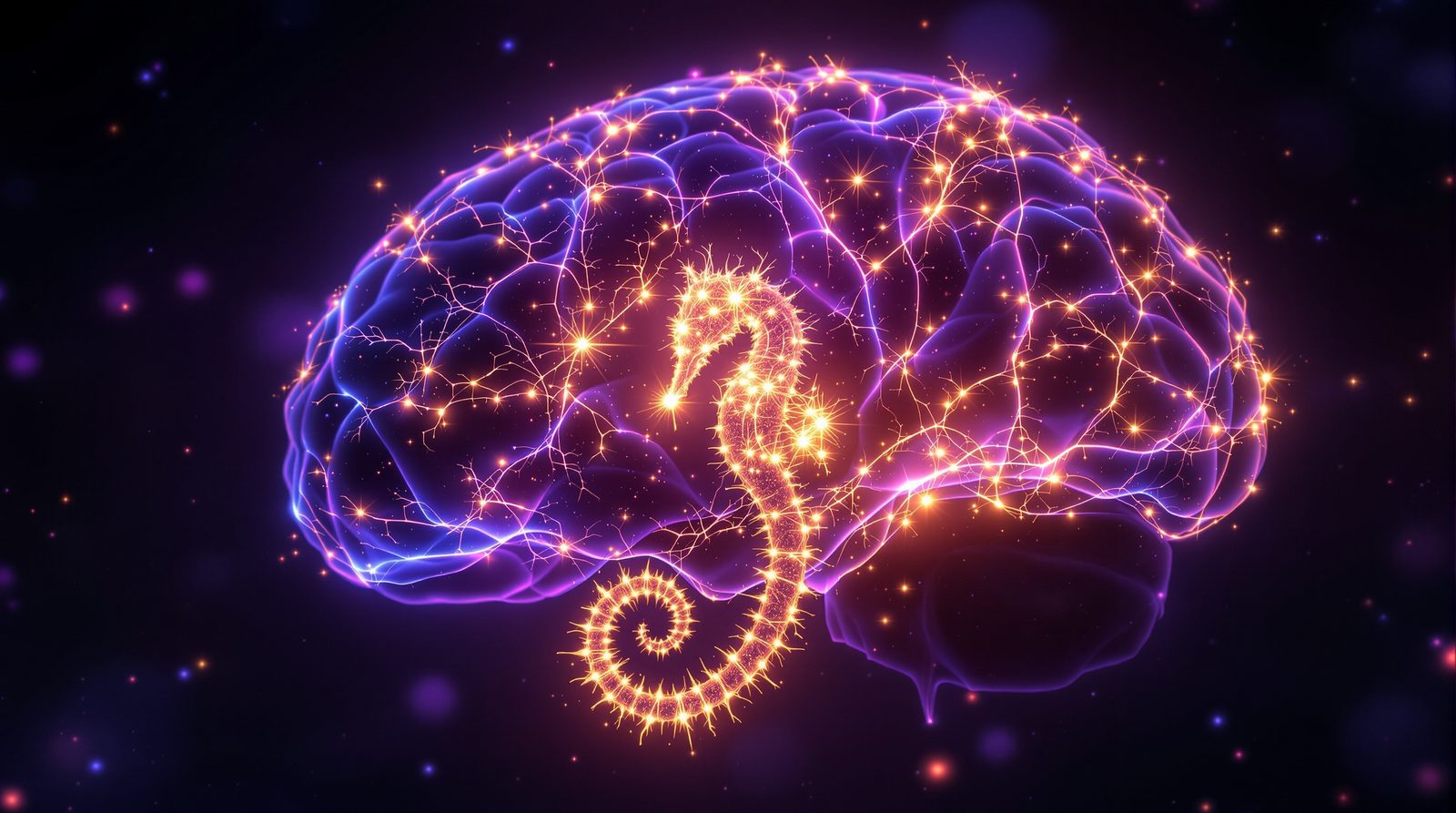
The hippocampus is named for the Greek hippokampos — "seahorse" — for its curled shape, and it is the brain's workshop for forming new declarative memories. The cellular event widely regarded as the physical basis of memory, long-term potentiation (LTP), is fundamentally a calcium story. When a synapse is stimulated strongly enough, calcium pours into the receiving neuron through NMDA receptors and voltage-gated channels; that calcium activates kinases such as CaMKII, which strengthen the synapse and make the memory stick.[3]
So the hippocampus is the place where "calcium is the switch" is most literally true. Anything that perturbs neuronal calcium handling does not perturb some abstract chemistry — it touches the machinery of learning itself. That is why EMF-and-calcium research keeps returning to this structure, and why the stakes of getting the framing right are higher here than anywhere else in this Journal.
How an electromagnetic field moves calcium
There are several documented routes, and they reinforce each other.
The historic windows: Bawin and Adey
The story begins in 1976, when Suzanne Bawin and W. Ross Adey reported that weak, low-frequency electric fields changed calcium binding and efflux in brain tissue — and, strikingly, only within specific "windows" of frequency and intensity, not in a simple dose-dependent line.[2] Carl Blackman's group extended this through the 1980s, showing the effect also depended on the local static magnetic field[7] — the same window-dependence that animates the ion cyclotron resonance debate. The calcium-efflux finding is one of the oldest and most-replicated non-thermal EMF effects on the brain.
The modern mechanism: voltage-gated calcium channels
The most influential contemporary framework belongs to Martin Pall, who synthesized dozens of studies into the proposal that EMFs act primarily by activating voltage-gated calcium channels (VGCCs) in the cell membrane.[1] The supporting evidence is that L-type and other VGCC blockers sharply reduce many EMF effects — if you plug the channel, the effect largely disappears. EMF activation of VGCCs produces a rapid rise in intracellular calcium (and a calmodulin-dependent burst of nitric oxide within seconds), fast enough that the channel itself appears to be the direct target.[1]
Stores and receptors: ryanodine, SERCA, NMDA
Calcium that enters can be amplified from internal stores via ryanodine receptors and recaptured by the SERCA pump. A 2025 study in the Annals of the New York Academy of Sciences found that blocking ryanodine-receptor release (with dantrolene) or store re-uptake (SERCA inhibition) abolished an EMF-induced change in neuronal excitability — direct evidence that calcium-store handling is part of the pathway.[4] And in rat hippocampus specifically, extremely-low-frequency exposure was shown to raise intracellular calcium alongside altered NMDA-receptor function and shifted activity of calcium-dependent enzymes — PKC, calcineurin, and CaMKII.[3]
- Step 1 · Channel The field activates voltage-gated calcium channels EMF exposure opens VGCCs in the neuronal membrane; calcium rushes down its steep gradient into the cell within seconds. VGCC blockers abolish the effect.[1]
- Step 2 · Amplify Internal stores release more calcium The initial influx triggers ryanodine-receptor release from the endoplasmic reticulum; SERCA pumps recapture it. Blocking either disrupts the EMF response.[4]
- Step 3 · Decode Calcium-dependent enzymes change activity Raised calcium shifts PKC, calcineurin and CaMKII activity and modulates NMDA-receptor function in the hippocampus — the decoders of the calcium signal.[3]
- Step 4 · Plasticity Synaptic strength is nudged Because these are the same molecules that run long-term potentiation, the field's calcium signal lands directly on the substrate of learning and memory.[3]
- Step 5 · Fork Toward benefit — or toward harm The same calcium entry can run to nitric oxide → cGMP → protein kinase G (a regenerative path) or to nitric oxide → peroxynitrite → oxidative stress (a damaging one). Dose and context decide.[1]
The double edge — said plainly
Here is the part a less honest brand would skip. The very mechanism that makes EMF-calcium interesting for wellness is the same mechanism implicated in EMF harm. Pall's own framework is explicit about this: downstream of the calcium influx, the signal can branch toward a beneficial pathway (calcium → nitric oxide → cGMP → protein kinase G, associated with healing and regeneration) or toward a harmful one (calcium → nitric oxide → peroxynitrite, associated with oxidative and nitrosative stress).[1] The same author who maps the therapeutic possibility has also argued that chronic low-intensity EMF exposure, via this very VGCC mechanism, may contribute to neurological harm.[6]
This is not a contradiction to be hidden; it is the biology being honest. It is the same hormetic, biphasic logic that runs through the entire wellness-technology field: the dose makes the medicine or the poison. A brief, low-level, calming exposure is a different stimulus from chronic, high-intensity bombardment, even when the molecular doorway is the same. Anyone who tells you EMF-on-the-brain is simply good — or simply bad — is not reading the literature.
Calcium is the universal second messenger, and in the hippocampus it is the substrate of memory (LTP). Electromagnetic fields demonstrably modulate neuronal calcium — through voltage-gated calcium channels (Pall), the historic Bawin–Adey efflux windows, ryanodine/SERCA store dynamics (Bertagna 2025), and NMDA-receptor and kinase activity (Manikonda 2007). These in-vitro and animal findings are well-documented; clean translation to human cognition is earlier-stage and unsettled. Crucially, the mechanism is double-edged: the same calcium entry can run toward benefit or toward harm depending on dose and context. Tesla BioLights makes no cognitive, memory, or neurological claims — it is a broadband, wellness-experiential modality, and the honest reading is that this domain cuts both ways.
The Tesla BioLights connection
Let this be unambiguous: Tesla BioLights makes no claim to improve memory, cognition, or any neurological function. This essay explains a mechanism domain — how electromagnetic fields interface with the brain's calcium machinery — not a benefit of the device. Given that the calcium literature explicitly cuts both ways, overclaiming here would be the opposite of honest.
What Tesla BioLights does occupy is the gentle, low-intensity, short-session end of the spectrum, and the experience people report is one of calm rather than stimulation — the parasympathetic, vagal lane covered earlier in this Journal, not cognitive enhancement. The reason to understand the calcium story at all is the same reason this Journal exists: to map the real science of the category honestly, including the parts that argue for caution. The fuller mechanism picture lives in the PEMF Research Hub.
Quick answers
How do EMFs affect calcium in the brain?
Chiefly by activating voltage-gated calcium channels (Pall 2013), raising intracellular calcium within seconds, with amplification from ryanodine-receptor stores and effects on NMDA receptors. The classic Bawin–Adey work (1976) first showed weak low-frequency fields change brain-tissue calcium at specific frequency/intensity windows.
Why does the hippocampus matter here?
It's the brain's memory-forming hub, and its key mechanism — long-term potentiation — is calcium-dependent (NMDA receptors, CaMKII). Anything that perturbs neuronal calcium intersects with the machinery of learning.
Is EMF on brain calcium good or bad?
Double-edged. The same calcium entry can run toward a beneficial pathway (Ca²⁺→NO→cGMP→PKG) or a harmful one (Ca²⁺→NO→peroxynitrite). Controlled low-dose is studied for benefit; chronic high-intensity exposure is hypothesized to harm. Dose and context decide.
What is a 'second messenger'?
Calcium is the cell's universal signaling currency. Because cells keep baseline calcium extremely low, even a tiny influx is a loud signal that switches on enzymes, gene expression and synaptic change (Berridge 2003) — which is why modulating it is so high-leverage and so double-edged.
Does Tesla BioLights improve memory?
No. Tesla BioLights makes no cognitive, memory, or neurological claims. This is a mechanism explainer, not a device benefit. It is a broadband wellness-experiential modality, and the honest reading of the calcium literature is that it cuts both ways.
Tomorrow on the Journal
Day 30 — Why Tesla BioLights Refuses to Make Medical Claims. The series finale, and the natural conclusion of an essay like this one. Thirty days of honest mechanism mapping arrive at a principle: when the science is real but double-edged and early, the only defensible posture is restraint. Why "we don't claim" is not weakness but the whole foundation of trust.
References
- Pall ML. Electromagnetic fields act via activation of voltage-gated calcium channels to produce beneficial or adverse effects. Journal of Cellular and Molecular Medicine. 2013;17(8):958-965. PMID 23802593. The canonical VGCC mechanism, explicitly bidirectional.
- Bawin SM, Adey WR. Sensitivity of calcium binding in cerebral tissue to weak environmental electric fields oscillating at low frequency. Proceedings of the National Academy of Sciences. 1976;73(6):1999-2003. PMID 1064869. The foundational calcium-efflux "window" finding.
- Manikonda PK, Rajendra P, Devendranath D, et al. Influence of extremely low frequency magnetic fields on Ca²⁺ signaling and NMDA receptor functions in rat hippocampus. Neuroscience Letters. 2007;413(2):145-149. PMID 17196332. ELF → ↑intracellular Ca²⁺, altered NMDA function, shifted PKC/calcineurin/CaMKII.
- Bertagna F, et al. Electromagnetic fields modulate neuronal membrane ionic currents through altered cellular calcium homeostasis. Annals of the New York Academy of Sciences. 2025. doi:10.1111/nyas.15386. Ryanodine-receptor (dantrolene) and SERCA dependence.
- Berridge MJ, Bootman MD, Roderick HL. Calcium signalling: dynamics, homeostasis and remodelling. Nature Reviews Molecular Cell Biology. 2003;4(7):517-529. PMID 12838335. The canonical calcium-second-messenger reference.
- Pall ML. Low Intensity Electromagnetic Fields Act via Voltage-Gated Calcium Channel Activation to Cause Very Early Onset Alzheimer's Disease: 18 Distinct Types of Evidence. Reviews on Environmental Health / related. 2022. PMID 35114921. The adverse-direction argument from the same mechanism.
- Blackman CF, Benane SG, Rabinowitz JR, House DE, Joines WT. A role for the magnetic field in the radiation-induced efflux of calcium ions from brain tissue in vitro. Bioelectromagnetics. 1985;6(4):327-337. PMID 4084833. Static-field dependence of the calcium-efflux effect.