
The Synapse: How One Neuron Speaks to the Next
Yesterday's spike raced to the end of the axon at a hundred metres a second — and then hit a cliff. Ahead lies the next cell, and between them a gap: the synapse. The electrical signal cannot simply leap it. So the body does something that ought to seem impossible for an "electrical" nervous system: at the edge of the cliff, it abandons electricity altogether. It converts the spike into a puff of chemistry, floats that chemistry across a cleft narrower than a wavelength of light, and rebuilds it into electricity on the far side — all in well under a millisecond, at an estimated hundred trillion connections in a single human brain. This is the strangest and most consequential twist in the whole story of how you work.
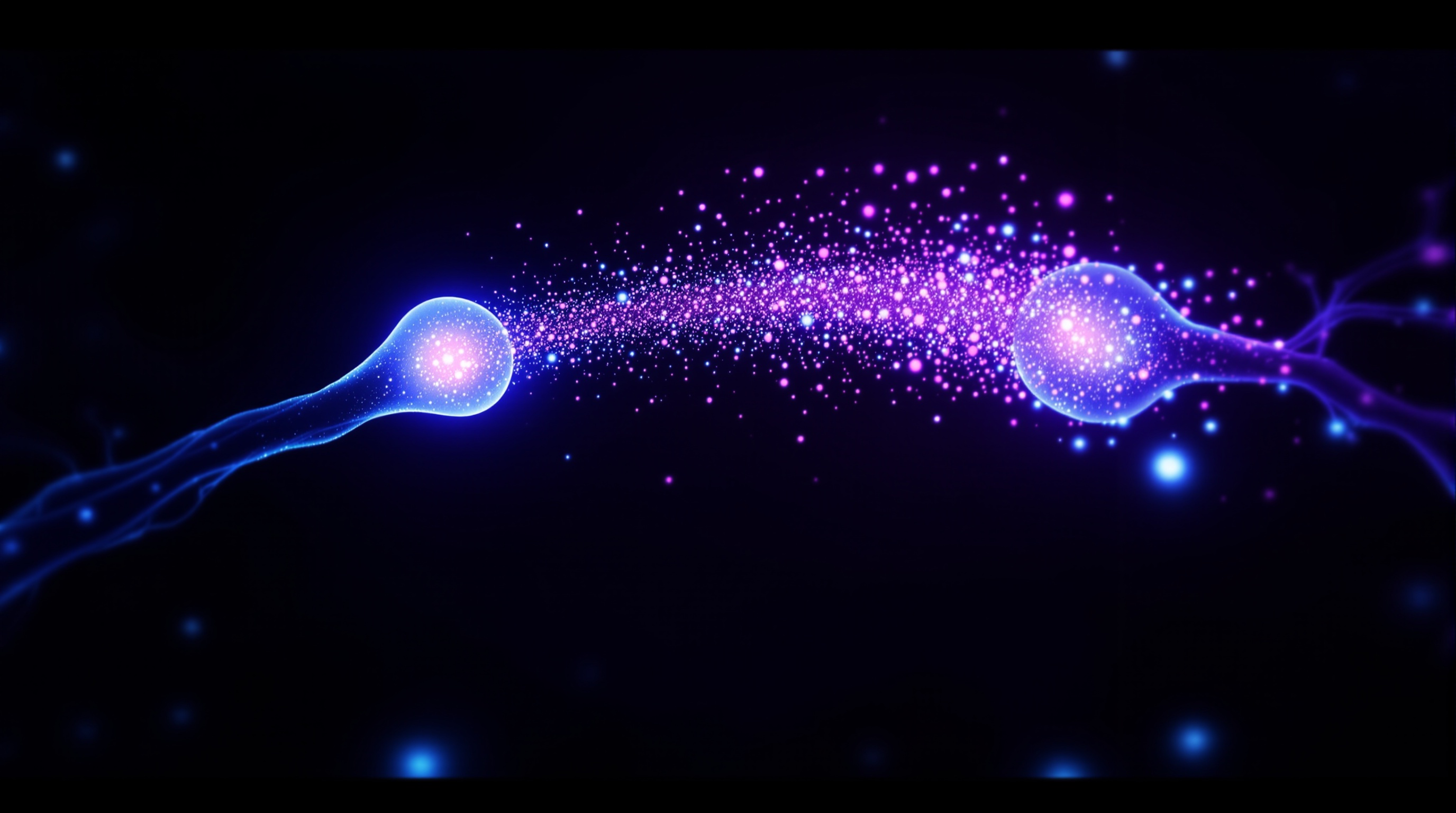
The gap that shouldn't be there
For a long time it was not obvious that the gap existed at all. In the late nineteenth century the great anatomist Camillo Golgi argued that the nervous system was a single continuous web, a reticulum, all its cells fused into one net. Santiago Ramón y Cajal, using Golgi's own silver stain, saw something different: discrete cells, reaching toward one another but never quite touching — the neuron doctrine. In one of history's great ironies the two men shared the 1906 Nobel Prize while holding opposite theories, and Cajal was right. It was Charles Sherrington who, in 1897, gave the still-hypothetical junction its name, from the Greek for "to clasp together."[5]
The tip of a twig of the arborescence is not continuous with but merely in contact with the substance of the dendrite or cell body on which it impinges. — Charles Sherrington, 1897, describing what he named the synapse
"Not continuous with but merely in contact." That small gap — we now know it is only tens of nanometers wide, roughly 20 to 40 across the typical cleft — is the whole problem the synapse exists to solve. An electrical spike is a wave of ions moving through a membrane; it has no way to jump an insulating gap of open space. Something has to carry the message across. The question of what touched off one of the most colorful fights in the history of biology.
Soups and sparks — and a dream
Two camps formed. The "sparks" believed transmission was electrical — the current simply crossing directly. The "soups" believed it was chemical — a substance released by one cell to act on the next. The dispute ran for decades and grew personal, with a famous stand-up argument between the physiologists Henry Dale and John Eccles. The decisive experiment came from Otto Loewi in 1921 — and it came, he said, in a dream. He awoke in the night with the design of an experiment, scribbled a note he couldn't read in the morning, and when the idea returned the following night, went straight to the laboratory.[3] He took two frog hearts. Stimulating the vagus nerve of the first slowed it, as expected — but then he took the fluid bathing that first heart and applied it to a second heart, with no nerve stimulation at all. The second heart slowed too. A chemical had carried the message. Loewi called it Vagusstoff — "vagus substance" — and it was later identified as acetylcholine. For proving chemical transmission he shared the 1936 Nobel Prize in Physiology or Medicine with Henry Dale, "for their discoveries relating to chemical transmission of nerve impulses."
The dream story is real, though Loewi — by his friends' accounts a wonderful storyteller — likely polished it over the years; the honest version is that a sleeping insight sent him to the bench, not that the whole discovery arrived by magic at three in the morning. And the war did not end in a total rout. Both camps, it turned out, were partly right: most synapses are chemical, but a minority are genuinely electrical (more on those below). The soups won the majority case; the sparks kept a real, smaller territory.
How the crossing actually works
Here is the sequence, and it is astonishingly fast. When the action potential arrives at the axon terminal, it opens a special class of gate we have not met yet: voltage-gated calcium channels. Calcium rushes into the terminal, and calcium is the trigger. It activates a set of proteins — the SNARE machinery — that haul the neuron's tiny storage bubbles, the synaptic vesicles, into the membrane and fuse them with it, spilling their cargo of neurotransmitter into the cleft.[1] Each vesicle holds a few thousand up to roughly ten thousand transmitter molecules; the fusion dumps them all at once. The transmitter diffuses across the tens-of-nanometers gap in microseconds and binds receptors on the far membrane.
Those receptors come in two flavors, and the difference matters. Ionotropic receptors are themselves ion channels: the transmitter binds, the channel opens instantly, ions flow, and the electrical signal is regenerated — fast, over in a few milliseconds. Metabotropic receptors work indirectly, through internal messenger cascades, and act more slowly — over seconds to minutes — but can reshape the cell more profoundly. Either way, the result is a small voltage change on the postsynaptic side: excitatory, nudging the next cell toward firing, or inhibitory, holding it back. A single neuron sums thousands of these nudges from thousands of synapses, in space and time, and only if the total crosses threshold does it fire a fresh action potential of its own. And then the transmitter must be cleared — pumped back into the terminal, taken up by neighboring glia, or chopped apart by enzymes like acetylcholinesterase — so the synapse is ready for the next message.
- Step 1 · The spike arrivesAction potential reaches the terminalThe spike depolarizes the presynaptic axon terminal at the edge of the cleft.
- Step 2 · Calcium floods inVoltage-gated Ca²⁺ channels openDepolarization opens Ca²⁺ channels; calcium rushes into the terminal and becomes the trigger for release.
- Step 3 · Vesicles fuse and releaseSNARE-driven exocytosisCa²⁺ activates the SNARE machinery (sensor: synaptotagmin); vesicles fuse and spill neurotransmitter into the cleft.[4]
- Step 4 · Receptors bindFast (ionotropic) or slow (metabotropic)Transmitter diffuses across in microseconds and binds postsynaptic receptors — ligand-gated channels (fast) or GPCRs (slow) — making an EPSP or IPSP.
- Step 5 · Response and clearanceSum to threshold, then resetThe next neuron sums its inputs and fires (or is inhibited); transmitter is cleared by reuptake, enzymes (e.g., acetylcholinesterase), or diffusion.
Counting the quanta
One more discovery turned the synapse from a picture into a precise machine. In the early 1950s Bernard Katz and colleagues, recording at the nerve–muscle junction, noticed tiny spontaneous blips of voltage even when no nerve fired — as if the synapse were leaking transmitter in fixed, identical packets. When a real signal arrived, the response was always a whole-number multiple of that smallest blip.[2] Katz concluded that transmitter is released not as a smooth stream but in discrete quanta — and each quantum, we now know, is the contents of one vesicle. Release is probabilistic: any given vesicle may or may not fire on a given spike, and synapses differ widely in how reliable they are. For revealing this quantal nature Katz shared the 1970 Nobel Prize. Decades later, the molecular machinery he had inferred was mapped in atomic detail by James Rothman, Randy Schekman, and Thomas Südhof — the SNARE proteins and the calcium sensor — earning the 2013 Nobel Prize "for their discoveries of machinery regulating vesicle traffic." Four Nobel Prizes, across a century, for one gap between two cells.
The minority report: electrical synapses
The "sparks" were not entirely wrong. A smaller class of synapses — the electrical ones — do let current pass directly. There, the two cells are joined by gap junctions: paired channels built of connexin proteins that open a direct passage between the cytoplasms, so ions flow from one cell straight into the next with almost no delay, usually in both directions. Electrical synapses are fast and excellent for synchronizing whole groups of cells, but they lack the flexibility of chemical ones — they cannot easily amplify, invert, or reshape a signal. In the mammalian brain they are the clear minority, but they are real, and they are why an honest account says the electrical signal usually cannot jump the gap, not never.
Where the honesty lives
The synapse is where a great deal of real medicine happens, and that is exactly what makes it the sharpest place to draw this Journal's line. Look at what genuine intervention here requires. An SSRI antidepressant blocks one named molecule — the serotonin transporter — to slow reuptake. A benzodiazepine modulates one named receptor, GABA-A. An acetylcholinesterase inhibitor targets one named enzyme (the same enzyme that nerve agents attack, at the lethal extreme — a reminder of how precisely these molecules act). Every one is a defined compound, aimed at a defined target, with measured effects and a documented list of risks. That is the standard of specificity synapses demand, because that is the specificity at which they operate — trillions of them, each running its own particular chemistry.
So when a device, a "frequency," a wearable, or a generic supplement claims to balance, boost, retune, or optimize your neurotransmitters and heal you, ask the questions real pharmacology always answers: which transmitter, at which receptor or transporter, in which direction, with what dose and what risks? A claim that cannot name its molecular target is not doing what an SSRI does; it is not operating in the same universe. The synapse's staggering specificity — the very thing that makes it a triumph of medicine — is what the wellness overclaim quietly ignores. And there is real frontier here worth naming honestly: synaptic plasticity, the strengthening of synapses with use (long-term potentiation, first shown by Bliss and Lømo in 1973[6]), is a robust phenomenon widely believed to underlie learning and memory — a leading, strongly supported hypothesis that is still an active research question, not a settled fact, and certainly not a dial a gadget can turn.
Established: at most synapses, chemical transmission bridges a cleft of tens of nanometers — the spike opens voltage-gated Ca²⁺ channels, Ca²⁺ triggers SNARE-mediated vesicle fusion, neurotransmitter is released in discrete quanta (Katz; Nobel 1970) and binds ionotropic (fast) or metabotropic (slow) receptors, producing an EPSP or IPSP; the postsynaptic cell sums inputs to threshold, then transmitter is cleared by reuptake, enzymes (e.g., acetylcholinesterase), or diffusion. History: Cajal's neuron doctrine vs Golgi's reticulum (Nobel 1906); Sherrington coined 'synapse' (1897); Loewi proved chemical transmission (1921; Nobel 1936 with Dale); the SNARE machinery mapped by Rothman, Schekman & Südhof (Nobel 2013). Electrical synapses (gap junctions/connexins) are the real, fast, bidirectional minority. Real neuropharmacology acts here — SSRIs (serotonin transporter), benzodiazepines (GABA-A), acetylcholinesterase inhibitors — as established, targeted medicine with named targets and known risks. Frontier (real, developing): synaptic plasticity/LTP as a substrate of learning & memory (Bliss & Lømo 1973 — strongly supported, still debated), connectomics, and glial/tripartite-synapse signaling. Rejected / overclaimed: any device, 'frequency,' or generic supplement claiming to 'balance,' 'boost,' 'retune,' or 'optimize' your neurotransmitters to heal — real intervention names one molecular target and its risks; a claim that cannot is a non-sequitur. Tesla BioLights makes no medical claims.
Quick answers
What is a synapse?
The junction where one neuron signals the next. At most synapses the cells don't touch — a cleft of tens of nanometers separates them — so the spike is converted to a chemical (a neurotransmitter) that crosses and acts on receptors. Sherrington coined the word in 1897; a human brain holds an estimated ~10¹⁴ synapses.
How does it transmit a signal?
The spike opens voltage-gated Ca²⁺ channels; Ca²⁺ triggers SNARE-mediated vesicle fusion, releasing neurotransmitter into the cleft; it binds ionotropic (fast) or metabotropic (slow) receptors, making an EPSP or IPSP; the cell sums inputs to threshold, then clears the transmitter.
Who proved synapses use chemicals?
Otto Loewi, in 1921 — transferring fluid from a vagus-stimulated frog heart to a second heart slowed it too, proving a chemical (Vagusstoff, later acetylcholine) carried the message. He said the design came in a dream; Nobel 1936 with Dale. Katz later showed release is quantal (Nobel 1970).
Chemical vs electrical synapses?
Most are chemical: slower (~0.5–1 ms delay), one-way, highly modifiable. Electrical synapses (gap junctions of connexins) are the minority: current passes directly, near-instant and usually bidirectional, good for synchronizing cells. Both are real — the "soups vs sparks" debate ended with chemistry winning the majority.
Can a device balance my neurotransmitters?
No general device or "frequency" can. Real intervention is specific — an SSRI hits one transporter, a benzodiazepine one receptor, each with known risks. That precision is exactly why "a gadget retunes your neurotransmitters to heal" is a non-sequitur.
Does Tesla BioLights claim any of this?
No. Zero medical claims. The synapse is real and Nobel-honored — precisely why "a device balances your neurotransmitters" doesn't follow. Plasticity and glial signaling are frontier research, not consumer therapy. Nothing here validates any product.
Bioelectric Mechanisms · The resting potential · The pump · The channels · The spike · The crossing · Biofield Hub →
Tomorrow on the Journal
Day 63 — Neuroplasticity: How Experience Rewires the Brain. We have watched a single synapse fire. Next: what happens when it fires again and again — how use strengthens connections, and where the real science of a changing brain ends and the marketing of "rewiring" begins.
References
- Physiology, Synapse. Caire MJ, Reddy V, Varacallo MA. StatPearls (NCBI Bookshelf), NBK526047. PMID 30252303. Cleft width, synaptic delay, Ca²⁺-triggered vesicle release, ionotropic vs metabotropic receptors, and transmitter clearance.
- del Castillo J, Katz B. Quantal components of the end-plate potential. J Physiol. 1954;124(3):560–573. DOI 10.1113/jphysiol.1954.sp005129. PMC1366292. Quantal (vesicle-sized) neurotransmitter release; foundation of Katz's 1970 Nobel Prize (Katz, von Euler, Axelrod).
- The Nobel Prize in Physiology or Medicine 1936 (Henry Dale, Otto Loewi), "for their discoveries relating to chemical transmission of nerve impulses." nobelprize.org. Loewi's 1921 Vagusstoff / frog-heart experiment and the "dream" account: Otto Loewi (1873–1961): Dreamer and Nobel Laureate, PMC4291908.
- The Nobel Prize in Physiology or Medicine 2013 (James Rothman, Randy Schekman, Thomas Südhof), "for their discoveries of machinery regulating vesicle traffic, a major transport system in our cells." nobelprize.org. The SNARE proteins and the Ca²⁺-sensor (synaptotagmin) of vesicle fusion.
- Sherrington and the naming of the synapse (1897). The term first appeared in Foster & Sherrington's A Textbook of Physiology, 7th ed. (original spelling "synapsis"); the Cajal–Golgi neuron doctrine shared the 1906 Nobel Prize. Sources: The synapse: people, words and connections, PMC9208269; Shepherd & Erulkar, PMID 9323432.
- Bliss TVP, Lømo T. Long-lasting potentiation of synaptic transmission in the dentate area of the anaesthetized rabbit following stimulation of the perforant path. J Physiol. 1973;232(2):331–356. PMID 4727084. Long-term potentiation (LTP) — the frontier link between synapses and memory (strongly supported, still debated).