Melatonin in the Dark: How Near-Infrared Light Reaches the Mitochondria
You know melatonin as the hormone of sleep — the molecule the pineal gland releases when the sun goes down, the "messenger of darkness." That story is true, and it is also only half the molecule. There is a second melatonin: made not in the brain but inside the mitochondria of nearly every cell in your body, in quantities that dwarf the pineal's, and not to tell time at all — to fight fire. It is the cell's own frontline antioxidant, produced exactly where the damage happens. And in a twist that reframes everything, one of its proposed triggers is not darkness but light: the near-infrared radiation that makes up most of sunlight, and that lives in the same optical window this technology occupies. This is the dark hormone's daytime story.
Two melatonins
For decades, melatonin meant one thing: the pineal gland's nightly secretion that rises in darkness, enters the bloodstream, and signals the body it is time to sleep. That pineal melatonin is real, circadian, and small in quantity — a hormone, a clock-hand.
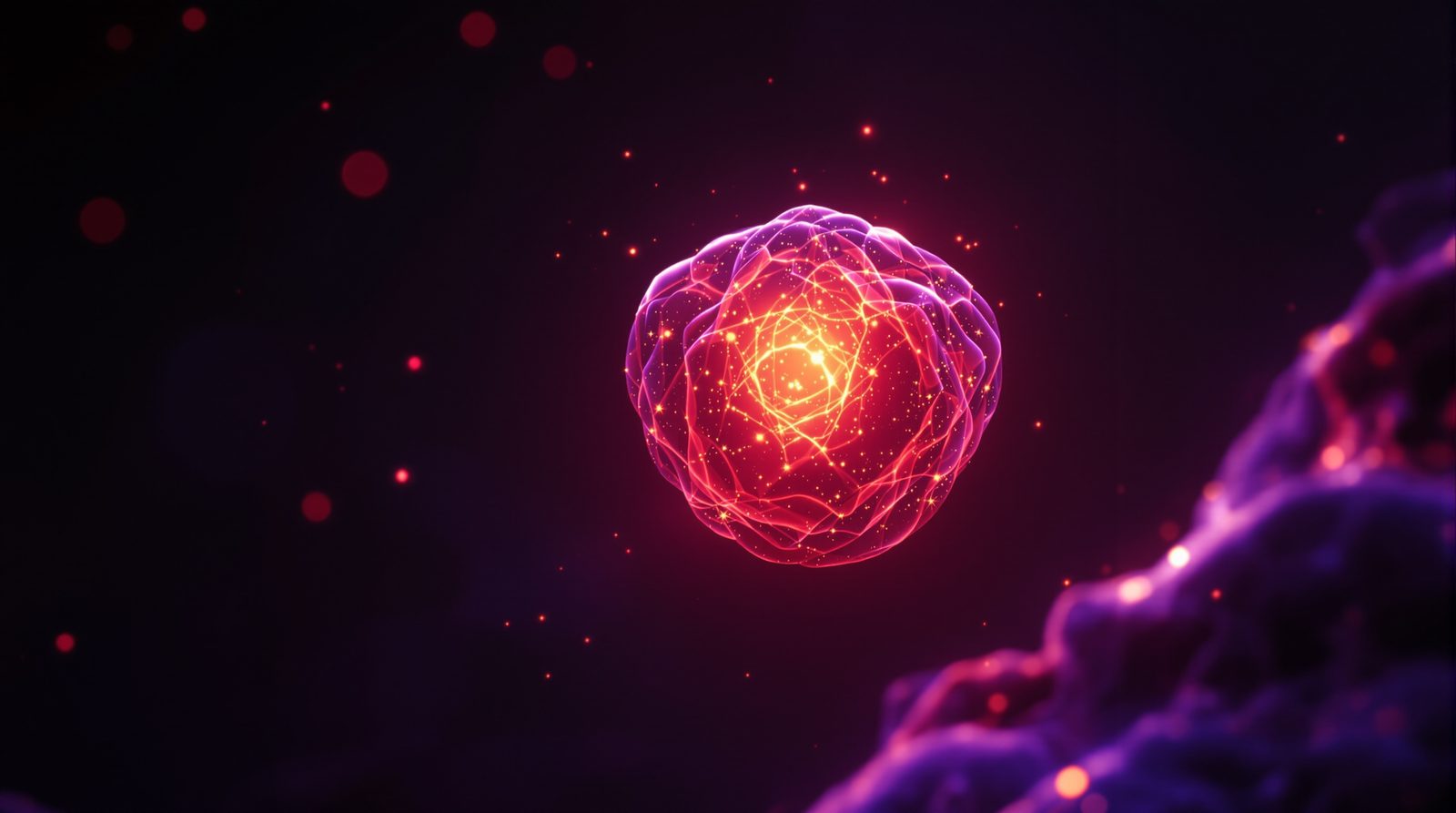
But over the last decade, the chronobiologist Russel Reiter and his colleague Dun-Xian Tan assembled a striking case for a different pool entirely. Subcellular melatonin is synthesized inside the mitochondria — the energy organelles — of nearly every cell. It is produced in amounts orders of magnitude larger than the pineal makes; it does not necessarily rise and fall with the day-night cycle; and it is not exported into the blood. It is made and consumed on the spot.[1]
Tan and Reiter argue this is not an accident of evolution but its logic. Mitochondria are thought to descend from ancient bacteria that already made melatonin billions of years ago; the molecule has been a cellular antioxidant since before there were animals to sleep. The pineal use — timekeeping — came late. The original job was protection.[1]
Why the mitochondrion makes its own
The reason is elegant once you see it. Mitochondria are the cell's power plants, and like all power plants they produce exhaust: reactive oxygen species (ROS), the free radicals generated as a byproduct of turning food and oxygen into ATP. ROS in small pulses are useful signals — as the anti-inflammatory mechanism essay described — but in excess they damage the very machinery that made them.
Melatonin is one of biology's most capable antioxidants. It neutralizes a broad range of radicals directly, its breakdown products are also antioxidants (a cascade Reiter calls the "antioxidant cascade"), and it up-regulates the cell's other defenses. Reiter's verdict, in the title of a much-cited review, is that as an antioxidant melatonin "under-promises but over-delivers."[4] Manufacturing it inside the organelle that generates the most free radicals is the most efficient possible defense — fire suppression built into the engine room.[1]
The near-infrared trigger
Here is where the story turns, and where it touches everything this Journal has covered. Reiter and Zimmerman's work on the optics of the human body asks a simple question: what light actually reaches our cells?[2] The answer is that near-infrared light — roughly 700 to 1100+ nm, a large fraction of natural sunlight — penetrates skin and tissue far more deeply than visible light, reaching muscle, and plausibly the mitochondria within.
Reiter's central hypothesis follows: that this penetrating near-infrared light stimulates mitochondrial melatonin synthesis, and that part of the long-recognized benefit of sunlight — and of photobiomodulation — may be mediated by the local melatonin that NIR switches on.[3] Melatonin would then be, in his memorable framing, "both a messenger of darkness and a participant in the cellular actions of non-visible solar radiation of near-infrared light."[3]
Crucially, this sits right on top of the mechanism we already mapped. Near-infrared is the same 600–1100 nm optical window in which cytochrome c oxidase absorbs light to drive photobiomodulation.[5] So the same photons that boost ATP through CcO may, on this hypothesis, also prompt the mitochondrion to make more of its own antioxidant. One window; two complementary effects.
- Step 1 · PenetrationNear-infrared light reaches deep tissueNIR (≈700–1100+ nm), a major fraction of sunlight, passes through skin far more deeply than visible light, reaching cells and their mitochondria — the optics of the human body.[2]
- Step 2 · AbsorptionCytochrome c oxidase catches the photonIn the same optical window, CcO absorbs NIR and accelerates ATP production — the established photobiomodulation pathway.[5]
- Step 3 · Synthesis (hypothesis)Mitochondria up-regulate local melatoninReiter proposes NIR stimulates mitochondrial melatonin production — a large, on-site, non-circadian pool distinct from pineal melatonin.[3]
- Step 4 · DefenseFree radicals are quenched at the sourceLocal melatonin neutralizes mitochondrial ROS directly, spawns antioxidant breakdown products, and boosts other defenses — the antioxidant cascade.[4]
- Step 5 · ResilienceThe cell holds its redox balanceThe net proposed effect: better-protected mitochondria and steadier cellular energy — a candidate molecular thread beneath the felt calm of light exposure.
"Melatonin is a mitochondria-targeted antioxidant… the mitochondria are the birthplace, the battleground, and the site of melatonin's metabolism in the cell." — paraphrased from Tan & Reiter, Melatonin Research, 2019
The modern, near-infrared-poor world
There is a quietly unsettling corollary. If near-infrared light helps switch on the cell's own antioxidant, then the way most of us now live — indoors, under LED and fluorescent lighting and screens that emit almost no near-infrared, behind glass that filters much of it out — may leave us chronically under-exposed to a wavelength our mitochondria evolved alongside.[3] Sunlight is roughly half near-infrared; an office is not. Whether that "NIR deficiency" has the consequences the hypothesis implies is exactly the kind of question that is still being worked out — but it reframes the old wellness instinct to "get some sun" in molecular terms, and it explains why the conversation around red and near-infrared light has grown so quickly.
Two things are well-supported: mitochondria synthesize melatonin (Tan & Reiter), and melatonin is a potent, broad-spectrum antioxidant (Reiter). One thing is a strong, actively-researched hypothesis, not a settled clinical fact: that near-infrared light up-regulates mitochondrial melatonin in humans and thereby mediates specific health benefits. Near-infrared does sit in the same 600–1100 nm optical window where cytochrome c oxidase drives established photobiomodulation. Tesla BioLights emits across that window but makes no claim to raise melatonin, improve sleep, or treat any condition — it is a broadband, wellness-experiential modality. This essay maps a mechanism domain, not a device benefit.
The Tesla BioLights connection
The reason this belongs in the Journal is the optical window. The noble-gas plasma of the S.E.A.D. System emits across the 600–1100 nm band — the same range where cytochrome c oxidase absorbs and where Reiter's near-infrared hypothesis operates. That is the honest extent of the connection: Tesla BioLights works in the wavelength territory this biology describes. We do not claim a session raises your mitochondrial melatonin, fixes your sleep, or does anything medical; we describe the mechanism domain and let your own experience speak. The fuller photonic map lives in the Photobiomodulation Research Hub.
There is a poetry to it worth naming. The hormone we associate with darkness turns out to be, at the cellular level, partly a creature of light — made deepest where the light reaches deepest, defending the engine that the light also fuels. Darkness and light, the same molecule. That is the kind of unity this Journal keeps finding when it looks closely and tells the truth.
Quick answers
Are there two kinds of melatonin?
Functionally yes — pineal melatonin (circadian, released into blood at night, the sleep signal) and subcellular melatonin (made in the mitochondria of most cells, far larger in quantity, consumed locally as an antioxidant, not necessarily circadian). Tan & Reiter document the mitochondrial pool.
Why do mitochondria make melatonin?
They generate the most free radicals (ROS) while making ATP, so producing a potent antioxidant on-site is efficient defense. Melatonin also triggers an "antioxidant cascade" and boosts other defenses (Reiter).
What does near-infrared light have to do with it?
NIR makes up much of sunlight and penetrates tissue deeply. Reiter hypothesizes it up-regulates mitochondrial melatonin — and it sits in the same 600–1100 nm window where cytochrome c oxidase drives established photobiomodulation.
Is the NIR-melatonin link proven?
The mitochondrial source and the antioxidant power are well-supported. The NIR-induction in humans, and its specific health benefits, is a strong but still-developing hypothesis — we present it as such.
Does Tesla BioLights raise melatonin or treat sleep?
No. It makes no such claim. It emits in the optical window this biology describes; that is the only connection. It is a broadband wellness-experiential modality, not a medical device.
Tomorrow on the Journal
Day 32 — The Fourth Phase of Water: Gerald Pollack's Exclusion Zone. A new arc continues into one of the most intriguing — and debated — ideas in the field: that water against living surfaces organizes into a charge-separated, liquid-crystalline "fourth phase," built by infrared energy. The science, the lab evidence, and the honest boundary of the claim.
References
- Tan DX, Reiter RJ. Mitochondria: the birthplace, battleground and the site of melatonin metabolism in cells. Melatonin Research. 2019;2(2):44-66. The case for mitochondrial (subcellular) melatonin as the larger, ancestral, antioxidant pool.
- Zimmerman S, Reiter RJ. Melatonin and the optics of the human body. Melatonin Research. 2019;2(1):138-160. How near-infrared light penetrates tissue and the implications for cellular melatonin.
- Reiter RJ, et al. Melatonin: both a messenger of darkness and a participant in the cellular actions of non-visible solar radiation of near-infrared light. Biology / Melatonin Research. 2023. The central NIR-stimulates-mitochondrial-melatonin hypothesis.
- Reiter RJ, Mayo JC, Tan DX, et al. Melatonin as an antioxidant: under promises but over delivers. Journal of Pineal Research. 2016;61(3):253-278. PMID 27500468. The canonical melatonin-antioxidant reference.
- Karu TI. Multiple roles of cytochrome c oxidase in mammalian cells under action of red and IR-A radiation. IUBMB Life. 2010;62(8):607-610. PMID 20681024. The cytochrome c oxidase photoreceptor in the 600–1100 nm optical window.